
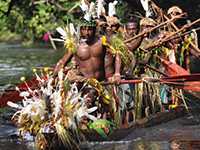
From Papua New Guinea to the tar sands of Alberta, Canada, native people…
Standing on Sacred Ground: Islands of Sanctuary
- Description
- Reviews
- Citation
- Cataloging
- Transcript
If you are not affiliated with a college or university, and are interested in watching this film, please register as an individual and login to rent this film. Already registered? Login to rent this film. This film is also available on our home streaming platform, OVID.tv.
Native Hawaiians and Aboriginal Australians resist threats to their sacred places in a growing international movement to defend human rights and protect the environment. In Australia's Northern Territory, Aboriginal clans maintain Indigenous Protected Areas and resist the destructive effects of a mining boom. In Hawai`i, indigenous ecological and spiritual practices are used to restore the sacred island of Kaho`olawe after 50 years of military use as a bombing range.
Featuring Patrick Dodson (Yawuru), Emmett Aluli and Davianna McGregor (Hawai`i), Winona LaDuke (Anishinaabe), Oren Lyons (Onondaga), Satish Kumar and Barry Lopez.
136-page Teacher's Guide (PDF) for the Standing on Sacred Ground series
'This monumental film series is superb. For many indigenous cultures throughout the world, sacred places are arenas of peace, power, and reverence. Standing On Sacred Ground sheds light on cases where religion and identity are under attack, where sacred places are being recklessly transformed into a focus of conflict, power struggles, desecration, and the violation of human rights. The films will prove to be of special interest to a wide range of scientific and academic disciplines, government and NGO personnel, and the general public. They will be most relevant for university, college, and high school classrooms covering subjects in anthropology, ecology, economic development, environmental studies, globalization, government, history, human rights, indigenous studies, law, social justice, sociology, political science, and religion.' Dr. Leslie E. Sponsel, Professor Emeritus of Anthropology, University of Hawaii at Manoa, Author, Spiritual Ecology: A Quiet Revolution
'Standing on Sacred Ground is a tour de force! This is one of the most powerful documentary series ever made on indigenous peoples and their resistance to environmental exploitation. Toby McLeod has woven stories of first nations peoples resilience amidst images of searing beauty and unimagined destruction. An awakening call indeed that should be heard around the world.' Mary Evelyn Tucker, School of Forestry and Environmental Studies, Yale University, Co-author, Ecology and Religion
'This is a crucial theme, extremely timely. The visually exquisite films are made politically and culturally relevant through impressive cooperation with articulate indigenous leaders who understand the importance of getting their voices heard about the environmental destruction of their sacred lands. The films are educational, accessible, and occasionally profound.' Marjorie Mandelstam Balzer, Research Professor, Center for Eurasian, Russian and Eastern European Studies, Department of Anthropology, Georgetown University, Author of Shamanic Worlds, Editor of Anthropology and Archeology of Eurasia
'Nothing like this riveting series of four desperately-urgent films about the fate of our planet has ever been seen...Patiently, lucidly and devastatingly, director Toby McLeod and his team have traveled the globe and painstakingly tracked eight stories of struggles by indigenous peoples to save the ancestral landscapes that have given them sustenance and spiritual anchoring for thousands of years. Standing on Sacred Ground is a magnificent, one-of-a-kind achievement...Containing face-offs at strategic sites, incontrovertible visual documentation of environmental wastelands, poignant voices of clarity and appeal that speak with the grave, quiet wisdom of cultures that have survived centuries of crusades to convert, exterminate, or assimilate them - these four dramatic films keep us on the edge of our seat and at the edge of tears. They absolutely must be seen by every citizen on earth.' Peter Nabokov, Anthropologist, Professor of World Arts and Cultures, University of California - Los Angeles
'An extraordinary film series highlighting the struggles, losses, and strengths of indigenous peoples working today to protect their sacred places in an industrialized world. Through beautifully filmed case studies where indigenous leaders speak for themselves, this series illustrates how history, law, science, and religion converge in the indigenous world and how critical these struggles are for the well-being of the planet as a whole.' Dr. Melissa K. Nelson, (Turtle Mountain Chippewa), Associate Professor of American Indian Studies at San Francisco State University, President of The Cultural Conservancy, Author of Original Instructions: Indigenous Teachings for a Sustainable Future
'From the local to the global, from the ancient world to the modern world, from developers to ecological preservationists, from indigenous peoples to outsiders, Standing on Sacred Ground explores the many sides of resource development on indigenous lands...The series provides considerable insight into the issues Indigenous Peoples face, and shows how and why they are fighting to preserve their sacred lands, their traditions, their life-ways, and their cultures. No study of contemporary ecological issues would be complete without hearing and seeing this aspect of ecology and development controversies.' Thomas D. Hall, Professor Emeritus of Sociology and Anthropology, DePauw University, Co-author, Indigenous Peoples and Globalization: Resistance and Revitalization
'Standing on Sacred Ground is one of the most powerful educational films, reminding us that Indigenous peoples are the true guardians of Mother Earth and their wisdom needs to be heeded - our future depends on it. Beautifully produced. Outstanding Indigenous commentary on the sacredness of Mother Earth and how we need to stop the plunder before we all vanish.' Dr. Julian Kunnie, Professor of Religious Studies/Classics, University of Arizona, Author, Indigenous Wisdom and Power: Affirming our Knowledge Through Narratives
'This important educational documentary demonstrates the unsustainable cost of rampant resource extraction and development and the devastating impacts on those who hold sacred the duty to protect the earth, Indigenous peoples. In documenting cases from the Pacific to the remote mountains of Altai and across the Americas, it demonstrates the vital importance of traditional Indigenous knowledge in the preservation of biodiversity and shows that, far from being a primitive relic from the past, Indigenous knowledge is vital to the recovery of the biosphere and to our collective future existence. This is a well-executed documentary, suitable for post-secondary educational programs.' Makere Stewart-Harawira, Associate Professor of Theoretical, Cultural and International Studies in Education, University of Alberta, Author, The New Imperial Order: Indigenous Responses to Globalization
'Beautifully illuminates indigenous peoples' resistance to environmental devastation and their determination to protect our common future.' Robert Redford
'Words that seem most appropriate in characterizing this documentary include awesome, beautiful, ugly, dramatic, revealing, disturbing, heroic, moving, and inspiring...A unique and historic achievement...The film exposes contemporary cultural, ecological, religious, and political realities, transcending the usual 'just-so-stories' of the ethnographic present dominating many textbooks. The film both tests anthropological viewers' adherence to cultural relativism and challenges any scientism because for indigenes nature is alive and spiritual with its sacred foci of power, reverence, and healing...This educational film series is most relevant for instructors and students in universities, colleges, and high schools for a wide variety of disciplines, topics, and courses. The four DVDs will allow instructors to easily use any of the individual eight cases, each 25 minutes long, making the series ideal for classroom use, or for students to pursue their individual interests.' Anthropology News (April 2014)
'Moving...A beautiful and informative series, which should cause Westerners to rethink their (lack of) relationship to land and nature...Suitable for high school classes and college courses in cultural anthropology, anthropology of religion, anthropology of place, development anthropology, anthropology of endangered cultures, and Oceanian studies, as well as for general audiences.' Jack David Eller, Anthropology Review Database
'Standing on Sacred Ground does well to not only allow the voices and experiences of actual Indigenous peoples, scholars, and activists shine throughout the films, but also calls out to viewers asking them what they can do for the land so 'the land can love them back.' This film series is thorough, critically engaging, inclusive, and very well produced. The eight case studies of Indigenous communities around the world offer the viewer a glimpse into the everyday lives of these people and can therefore be an excellent educational tool for students and activists of most ages. I highly recommend this film series for anyone who wants to learn about Indigenous cultures across the globe, as well as anyone who wants to fully understand how and why the earth is slowly being destroyed by the efforts of 'progress,' along with what they can do to help reverse the process of ecological destruction.' Jennifer Loft, University at Buffalo, Educational Media Reviews Online
Citation
Main credits
McLeod, Christopher (film director)
McLeod, Christopher (film producer)
Abbe, Jessica (film producer)
Abbe, Jessica (screenwriter)
Huang, Jennifer (film producer)
Greene, Graham (narrator)
Busby-Neff, Luana (storyteller)
Roberts, Rhoda (storyteller)
Other credits
Edited by Quinn Costello; director of photography, Will Parrinello, Andrew Black; composer, Stefan Smith, Charles Johnson, Kawika Kahiapo.
Distributor subjects
Activism; Anthropology; Australia; Biodiversity; Business Practices; Climate Change/Global Warming; Ecology; Environment; Environmental Ethics; Environmental Justice; Geography; Global Issues; Health; Human Rights; Humanities; Indigenous Peoples; Mining; Pacific Studies; Pollution; Religion; Sociology; Toxic ChemicalsKeywords
Aboriginal Australians, Native Hawaiians, reclaiming land from the government, reclaiming land from the military, resisting cultural erosion, resisting enviromental degradation, resisting threats to sacred places, international movement to defend human rights, protecting the environment, Northern Territory, Indigenous Protected Areas, resisting mining boom, indigenous ecological practices, spiritual practices, restoring sacred island, Kah'olawe, 50 years of military use, bombing range, Patrick Dodson, Emmett Aluli, Davianna McGregor, Winona LaDuke, Oren Lyons, Satish Kumar, Barry Lopez.; "Islands of Sanctuary"; Bullfrog Films; Standing on Sacred Ground,doc,env; science; religion; sociss
| Standing on Sacred Ground — Series Episode 4 | |||
| Islands of Sanctuary | |||
| Broadcast Transcript | |||
| Video and lower thirds | Name of speaker | Audio and subtitles | Timecode |
| Pan of rock art. Wamud's kids climb to rock art, see kangaroo painting. |
Music (Chuck Johnson and Stefan Smith) | 0:00:01 | |
| On-camera interview with Patrick Dodson. Cutaways to painted child and Garma Festival dancer. |
Patrick Dodson | We are born into a world where we already have meaning. We have meaning. Because we're born with a particular kinship. We're born with a name. We're born with a spirit being that will return to the land when we die. We know that. I think the West hasn't quite understood the need to have a spirituality that links to the land upon which they live. |
0:00:16 |
| Aboriginal man flies over McArthur River Mine surveying the area. Bomb blast, Kaho‘olawe. People arriving in surf on Kaho‘olawe, bags passed hand to hand on red dirt. |
Narrator: Graham Greene | Around the world, indigenous people fight for their islands of sanctuary – where restoration of the environment and culture go hand in hand. | 0:00:47 |
| Boy throws spear into sea. B&W historic photo of men in chains. On-camera interview with Galarrwuy Yunupingu. |
Galarrwuy Yunupingu | We can live on the land like nobody does. How come we lived this long and the Australian Government is still running around trying to kill us off? | 0:00:57 |
| Jacky Green confronts mine personal and consultants in SUVs. | Jacky Green | (subtitled) Stop selling us to the mine, mate. Don't sell us to the mine! | 0:01:07 |
| Smudging ceremony outside Supreme Court building. Bulldozers working at mine. Dhimmeru ranger with truck on beach | Narrator: Graham Greene | In Northern Australia, Aboriginal clans confront a mining boom––and fight to establish Indigenous Protected Areas. | 0:01:11 |
| Hawaiian rain ceremony. Davianna McGregor pours water; B&W historic helicopter photo from Kaho'olawe occupation. | Narrator: Graham Greene | And Native Hawaiiansrestore an island, regained after 50 years of bombing. | 0:01:21 |
| On-camera interview with Davianna McGregor. Cutaways to two fighter jets flying over ocean. Bomb drops. | Davianna McGregor | We had to challenge US control over this land with continued occupation in the face of the military. | 0:01:28 |
| Child holds stop the bombing sign. On-camera interview with Derek Mar. |
Derek Mar | If we can fight the most powerful armed force the world has ever known, and win, the possibilities are endless for other indigenous peoples throughout the world. | 0:01:36 |
| World map animated with lights. TITLE: Standing on Sacred Ground |
0:01:49 | ||
| CPB logo over rock art. | Narrator: Cedering Fox | Funding for the Standing on Sacred Ground series has been provided by the Corporation for Public Broadcasting. | 0:02:00 |
| TITLE: Islands of Sanctuary |
0:02:15 | ||
| TITLE: For many Aboriginal communities it is inappropriate to show images of people who have passed away. Individuals with this concern are warned that the following segment contains such footage. |
0:02:20 | ||
| Dancers with red flags at Garma festival. | music | 0:02:31 | |
| map: Northern Territory. Arnhem Land, Darwin. McArthur River, Gove Peninsula. | Narrator: Graham Greene | Australia's Northern Territory is marked by conflicts over Aboriginal lands: a mine on the McArthur River; the birthplace of the land rights movement on the Gove Peninsula; and in Arnhem Land, reclaimed country now under indigenous management. | 0:02:46 |
| Dean Yibarbuk walks into a cave and looks out at the landscape. | Narrator: Graham Greene | Unseen by Western eyes, song lines have guided Aboriginal culture since the era of creation – the Dreamtime. | 0:03:05 |
| Aerial of McArthur River | Malarndirri McCarthy | The land tracks around the Gulf Region are based on what we call song lines or gudjiga. | 0:03:17 |
| On-camera interview with Malarndirri McCarthy. LOWER THIRD: Malarndirri McCarthy Northern Territory Parliament (2005-2012) Cutaways to Wamud Namok and kids sitting; he sings. They walk. |
Malarndirri McCarthy | And that gudjiga tells the story like a map. It's the singing of the map of the country. So, when a person would walk across country they would sing that country and they would name that tree and they would name that river and they would name that rock. That way there was a sense of knowing, well this is where I am, I’m not lost. I can see that sacred site over there. |
0:03:23 |
| Wamud Namok explains rock art to children. | Wamud Namok | (subtitled) There are sacred sites all through here. The ancestors painted these images to teach young people about this place. We belong to this country here. | 0:03:50 |
| On-camera interview with Brendan Mackey. LOWER THIRD: Brendan Mackey Ecologist, Griffith University Cutaways to Wamud Namok and kids. |
Brendan Mackey | European humans have been on the Australian continent only for about 200 years. There’s absolutely clear archaeological evidence that Aboriginal people have been here for 50,000 years. It's the longest continuous existing culture that we know about on the planet. | 0:04:11 |
| Wamud Namok sitting in cave speaking with children. | Wamud Namok | laughing | 0:04:29 |
| Brendan Mackey walks with Dean Yibarbuk. | Brendan Mackey | And if you look around the world where nature is still in plenty, everywhere in those lands there are traditional people. | 0:04:31 |
| On-camera interview with Dean Yibarbuk. LOWER THIRD: Dean Yibarbuk Senior Fire Ecologist |
Dean Yibarbuk | The natural ecosystem still exists here. And that’s why it’s healthy, the people are healthy, countries are healthy. | 0:04:41 |
| Aerials of rocky landscape with trees. | Narrator: Graham Greene | The Arnhem Land Plateau is part of the biggest, oldest and most diverse tropical savannah in the world. In the last century, the plateau was abandoned by an essential species. People left Arnhem Land, lured by missions and white towns and the promise of protection from vigilantes. | 0:04:49 |
| Wamud Namok sitting in cave facing rock art and children. | Narrator: Graham Greene | After a half century of exile, Kunwinjku people have come back. Wamud Namok was the visionary artist who led his people back to Arnhem Land, where he lived as a child, sheltered under rocks now covered in his own paintings, and those thousands of years old. | 0:05:13 |
| On-camera interview with Wamud Namok | Wamud Namok | (subtitled)The country needs people on it. Then everything will work well. | 0:05:33 |
| Tilt down rock to art. On-camera interview with Dean Yibarbuk. Cutaways to Wamud Namok and people harvesting sugarbag honey. |
Dean Yibarbuk | It's a spiritual country. When we look at the whole landscape, people may think oh it's just an ordinary hill, or an ordinary rock. It's an object that is sacred to our understanding. His last wish is to bring people back and work in their own country as been done for thousands of years. |
0:05:44 |
| Narrator: Graham Greene | In the hunter-gatherer tradition, Aboriginal stewards of the land find food everywhere – and teach younger generations how to care for species like the sugarbag, a bee that makes hives in trees. | 0:06:12 | |
| On-camera interview with Brendan Mackey. | Brendan Mackey | For 50,000 years every plant and animal species that we see around us today, co-existed with Aboriginal people. So, for a start they must have been doing something right. | 0:06:29 |
| Wamud Namok and Wife sit on ground talking over each other. | Wamud and wife | Kunwinjku | 0:06:42 |
| Men put decal on car with Wamud Namok. Elders sit outside and talk. Fire seen from helicopter, men on ground conduct controlled burn. |
Narrator: Graham Greene | Wamud Namok lived long enough to see his homeland officially recognized as an Indigenous Protected Area. Land management decisions are once again made by clan elders, who have reintroduced traditional ways of taking care of country. Early-season controlled burns thin undergrowth without damaging big trees, and prevent catastrophic wildfires later in the season. | 0:06:49 |
| On-camera interview with Marcia Langton. LOWER THIRD: Marcia Langton Chair of Indigenous Studies, Univ. of Melbourne Cutaways to controlled burn and landscape aerials. |
Marcia Langton | The great accomplishment of aboriginal people was to learn how to tame this fire-prone continent by the intelligent use of fire. And, when the British came, what they found were park-like expanses of lightly-wooded pastures. And, they thought that they'd found Eden. And, they thought it was natural, but it wasn't natural. It was a human-made landscape. |
0:07:22 |
| Fire burns at night. Paintings of Aboriginal people with a fire, Colonials planting flag, Aboriginal woman hiding in bushes, soulful man's face and white men slaughtering Aboriginal men. | Marcia Langton | In 1770, Captain Cook declared the east coast of Australia a British possession. And thereafter, according to British law, aboriginal people were no longer the owners of their land. The Anglican chaplain to the colony declared that aboriginal people did not have souls. And this view justified the various attempts to eliminate local populations. |
0:07:56 |
| B&W photo of 7 men sitting on ground, defiant looking painted man, photo of Uluru; B&W photo of men painted and in regalia; painting on rock; B&W photo of men with spears, B&W photo of five painted men with boomerangs. | Narrator: Graham Greene | The English saw Australia as terra nullius, no man’s land, belonging to no one. The newcomers were blind to thousands of sacred natural sites revered by Aboriginal people as the dwelling places of spirit beings from an ancient past. Aboriginal defenders of their country were massacred or imprisoned. | 0:08:29 |
| B&W photos of men in chains. On-camera interview with Marcia Langton. |
Marcia Langton | European powers declared ownership over other people's lands, and enslaved peoples around the world or destroyed them. Modern Australia is the result of that history. |
0:09:00 |
| B& W photos: Smiling white nun holds two black children; group of schoolchildren; group of white officers with children; group with two nuns. | Narrator: Graham Greene | Stolen generations of children were given to mission schools or white families. Until the mid-1960s, Aboriginal people were governed under wildlife laws. | 0:09:15 |
| On-camera interview with Marcia Langton. | Marcia Langton | They simply couldn't believe that these primitives, as they called us, had a religion and that the religion was based on attachment to places imbued with ancestral beings. | 0:09:28 |
| B&W photos: Aboriginal man locked out of chain link fence; mining lease no entry sign; Men scale fence with no trespassing sign. | Patrick Dodson | The Western mind is linked to this private property notion. It's an absolutely diabolical concept to think that our relationship to that land is extinguished because some Western law says. | 0:09:43 |
| On-camera interview with Patrick Dodson. LOWER THIRD: Patrick Dodson Chairman, Kimberly Institute |
Patrick Dodson | It is madness. But our country has done that. | 0:09:56 |
| B&W footage of protestors marching with banners reading 'Support the Kimberly Land Council' and 'No Mining on Sacred Land.' | Protestors | No mining on sacred sites! | 0:10:00 |
| B&W archival footage of land-rights protests in Noonkanbah, tree bark petition and Tent Embassy protests at Canberra. B&W photos from land-rights movement around the country. B&W photo of 7 Aboriginal women at a site of significance. |
Narrator: Graham Greene | The land rights movement in Australia was triggered by mining on sacred sites. It began in the 1960s with a petition demanding respect for Aboriginal law, painted on tree bark. Lawsuits and a prolonged occupation of the Capitol at Canberra followed. In 1976, Australia's Northern Territory made history by enacting the world's first law to protect indigenous rights to sacred ground. But conflicts persist. |
0:10:03 |
| Scenic footage of landscape and wildlife. | Narrator: Graham Greene | The McArthur River is an important wildlife and conservation area, from the dry country to the estuary. | 0:10:52 |
| Steve Johnston drives a boat down the McArthur River. | Narrator: Graham Greene | In the last decade, the islands at the mouth of the river were returned to Aboriginal clans once again. The family of Steve Johnston still lives on "salt-water tucker:" food from the sea. But mining threatens the marine habitat. | 0:11:00 |
| Aerials of McArthur River mine, bulldozers, mining conveyor belt and footage of floods. | Narrator: Graham Greene | Sixty miles upstream, the McArthur River Mine extracts zinc from one of the world's largest deposits, and sells most of it to China – for rust-proofing steel in products from cars and bridges to office towers and war ships. For 20 years, locals have worried about the environmental impacts of extracting lead and zinc in the floodplain of a tropical river. |
0:11:17 |
| On-camera interview with Steve Johnston on his boat on the McArthur River. Cutaways to aerials of flooding. |
Steve Johnston: | In 2001 there was a big flood in the river. We had a good wet that year. And the tailing dams at the mine siteburst their walls and came down the river. There was thousands of dead fish out in the bay here. | 0:11:47 |
| Dying mangrove on the river. | Christopher McLeod | What do you think's killing the mangrove? | 0:12:05 |
| On-camera interview with Steve Johnston on his boat on the McArthur River. | Steve Johnston | Well I think it must be the poison from the mine. | 0:12:08 |
| McArthur River Mine signs, underground mining, footage of open-pit mining and McArthur River. Map shows planned river diversion. |
Narrator: Graham Greene | Two years after the big flood, global mining giant Xstrata acquired the McArthur River mine, and a plan was announced to convert underground tunnels into an open pit – a less expensive way to unearth the minerals. But the zinc deposit is directly beneath the McArthur River. Xstrata's solution? Move the river, an ancient pathway created by the Rainbow Serpent. |
0:12:12 |
| Animated rainbow serpent creates the river. | Storyteller: Rhoda Roberts | In the Dreaming, the Rainbow Serpent journeyed north, conjuring big storms and carving a broad and winding river in the raw earth. Sing to the river. Sing to country. Country will hear. But beware! The one who enforces the law is always watching. The spirit of the Rainbow Serpent still lives in the water. |
0:12:39 |
| On-camera interview with Malarndirri McCarthy. Cutaways to McArthur River. |
Malarndirri McCarthy: | It has been the river of life, a source of water and food and enjoyment for thousands and thousands of years. But it's also got an even more significant role in aboriginal culture, and that is the sense of spirituality and association with the river through the gudjiga of the rainbow serpent. Because it's the rainbow serpent that weaves its way across the country and creates the country. It is powerful, and it needs to be treated with much respect. |
0:13:07 |
| Protest sign at airport; "Our River is Our Life." Malarndirri McCarthy arrives at Borroloola. | Narrator: Graham Greene | Malarndirri McCarthy represented the McArthur River area in the Northern Territory Parliament. With other officials, she came to Borroloola to hear local concerns about the mining plan. | 0:13:41 |
| Philip Timothy speaking from audience at meeting in Borroloola. LOWER THIRD: Philip Timothy Traditional Land Owner |
Philip Timothy | That is the tail of the rainbow snake, and they’re gonna cut off that tail. Why don’t you think about aboriginal sites? That’s why we are losing our culture. | 0:13:53 |
| David Ritchie speaks from podium at meeting in Borroloola. LOWER THIRD: David Ritchie Dept. of Natural Resources Cutaway to Malarndirri McCarthy listening at meeting. |
David Ritchie | There are no sacred sites affected by this mine, and that's the report we've got, and we have to listen to that. | 0:14:04 |
| On-camera interview with Brain Hearne. LOWER THIRD: Brian Hearne Manager, McArthur River Mine Cutaways to aerials of McArthur River Mine and Aboriginal man surveying the area. |
Brian Hearne | One of first things we did when we started off with the proposal for the open pit at McArthur River was to identify all the cultural sites around the area. the Gudanji people came up and went through the sites of significance and we obtained the Aboriginal Areas Protection Authority certificates for the works that we want to do. And there’s no sacred sites affected as far as they’re concerned. | 0:14:12 |
| On-camera interview with John Kundereri Moriarty LOWER THIRD: John Kundereri Moriarty Yanyuwa, Mining Consultant Cutaways to the streets of Borroloola. |
John Kundereri Moriarty | I think the mine can be the economic generator of the region. We’ve never had anything like that before. Mining is one of those industries that can link in with a rural tradition like ours. At the moment it's television, grog, drugs that is capturing a lot of our people. The mine can give the Aboriginal people here a normal life as is possible out here. |
0:14:40 |
| Footage of McArthur River mine and water testing. | Narrator: Graham Greene | For the first 15 years of operation, the mine paid no royalties, and received millions in government subsidies. Most employees were flown in. Recently, Xstrata has hired some local workers and has started contributing to a community fund. Contaminants released by earlier floods weren't documented by the mine or the government, but independent monitoring of water quality is now required. | 0:15:12 |
| On-camera interview with John Kundereri Moriarty Cutaways to flowing water. |
John Kundereri Moriarty | I was born across the river there. So we have a stake in what comes downstream from the mine. And it's been stated that the water is poisoned here. And that’s totally wrong. |
0:15:40 |
| On-camera interview with Steve Johnston. | Steve Johnston | They say we can’t eat the mussels. We can’t eat the oysters. So, that’s coming from doctors. They reckon there’s too much heavy metals in 'em. | 0:15:53 |
| Steve Johnston's family around the homestead. | Narrator: Graham Greene | Human health depends on the health of the land and water. But Aboriginal culture also depends on respect for the land, as the dwelling place of the sacred. | 0:16:05 |
| Steve Johnston shows Rainbow Serpent tracks on illustrated map. | Steve Johnston | Now this line here is the Rainbow Serpent coming down the McArthur River. There is dreaming tracks right up to the headwaters of the McArthur River all the way from Borroloola up to McArthur Mine itself. |
0:16:17 |
| On-camera interview with Marcia Langton. | Marcia Langton | Aboriginal people who follow the old traditions believe that the most important sites are the places where the ancestral beings remain in their place. That's where they live, and they live there forever. | 0:16:34 |
| Children playing in water. TITLE: Upstream McArthur River |
nat sound of children playing in river | 0:16:48 | |
| Women paint each other and children in preparation for ceremony. | Marcia Langton | There's always a set of rules about how one approaches rainbow serpent places. So, for instance one must go with the senior traditional owner. | 0:16:52 |
| On-camera interview with Harry Lansen LOWER THIRD: Harry Lansen Traditional Owner, McArthur River |
Narrator: Graham Greene | Senior traditional owner Harry Lansen was not one of Xstrata's paid consultants. | 0:17:07 |
| Harry Lansen speaking while sitting near McArthur River with other residents. | Harry Lansen | (subtitled) They say it's white man's property, white man's law. But our law is going to be there forever. | 0:17:12 |
| Pan from Harry Lansen's face to Asman Rory talking. LOWER THIRD: Asman Rory Gudanji Activist |
Asman Rory | They knew he was the right person to see, but they was working around him, working around him every time. | 0:17:20 |
| Women singing and dancing by the river. | Asman Rory | They got no right to tell us what to do. It's our country. It's our land right here now. | 0:17:31 |
| Painted women dance in yellow skirts by the river. | singing | 00:17;38 | |
| Mine officials and advisors approach the group in SUV's and helicopter. Children flee through the water. Jacky Green approaches the vehicles. | Narrator: Graham Greene | When Gudanji families tried to visit their sacred sites near the McArthur River Mine, they were blocked by company personnel and their aboriginal consultants, and threatened with arrest for trespassing. | 0:17:52 |
| Jacky Green confronts mine personal and consultants in SUVs. | Jacky Green | (Subtitled) Stop selling us to the mine, mate. Stop selling us to the mine. We're Gudanji people. Don't sell us. | 0:18:03 |
| Harry Lansen and Asman Rory watch with concern. On-camera interview with Jacky Green. LOWER THIRD: Jacky Green Gudanji Ranger |
Jacky Green | But we couldn’t get back in there today, that really hurt. They came and with two vehicles stop us, and the chopper. | 0:18:14 |
| Aerial of McArthur River Mine with overlay of newspaper headlines reading 'Traditional owners challenge McArthur River Mine expansion' and 'Court puts brakes on Xstrata's $110m zinc mine plan.' | Narrator: Graham Greene | Xstrata's request to move the McArthur River was denied – but mining company bulldozers broke ground on the river diversion anyway. So Aboriginal custodians sued, and the court ruled in their favor. | 0:18:22 |
| On-camera interview with Malarndirri McCarthy. | Malarndirri McCarthy: | It was a win for the Aboriginal people in the Gulf Region. And on that day when the judge made the announcement all work on the expansion plan had to stop, because it was illegal. | 0:18:36 |
| On-camera interview with Steve Johnston. | Steve Johnston | They were beaten in the court, but then they just turned around and legislated the day after and made new rules. | 0:18:47 |
| Press conference outside Parliament, Claire Martin speaking to reporters. LOWER THIRD: Claire Martin Chief Minister, Northern Territory Cutaways to banner reading 'Don't muck up the McArthur' and reporters. |
Claire Martin | Today government has decided to legislate to ensure the continued operation of the open cut section of the McArthur River Mine. There's hundreds of jobs there. And Cabinet made a decision based on a lot of facts that we had before us and this is the most efficient way to move. | 0:18:56 |
| Claire Martin walking away, Charles Roche holding banner. | Voice of Charles Roche | What are you going to say to the traditional owners about their river? When are you going to tell the traditional owners, Claire? | 0:19:12 |
| Mine site sign, big truck drives by. | 0:19:19 | ||
| Jacky Green addresses group of Aboriginal men. Picks up dirt. Points to countryside. |
Jacky Green | We're all together, we must fight this thing. This ground here, look it's Gundanji an' Mambalya country! Over here they’ve been damagin' country blungawi. They’re frightened to show us. We will start as one, and we’ll finish as one! |
0:19:20 |
| People from the community load bus for trip to Darwin. People take the 17-hour bus trip to Darwin. | Narrator: Graham Greene | With bulldozers at work re-channeling the sacred river, a delegation of elders traveled 17 hours to Darwin to protest government collusion with industry. | 0:19:42 |
| On-camera interview with Elaine Timothy sitting beside river with elder. | Elaine Timothy | They crushed our sacred site. They never listen to Aboriginal people, elders, senior elders. Y'know they’ve been stomped on. So it’s time for them to stand up and say: "Hey, you’re not doing this to me anymore." | 0:19:55 |
| Aerial shot of Supreme Court and Parliament in Darwin. TITLE: Supreme Court and Parliament Darwin, Northern Territory People hold smudging ceremony at the Supreme Court. |
music | 0:20:09 | |
| On-camera interview with Malarndirri McCarthy. Cutaways to people at Supreme Court. |
Malarndirri McCarthy | Our people had taken a government and company to court and had won, and felt vindicated by the win, and then felt absolutely demoralized when goalposts were being moved again. | 0:20:21 |
| Women dance in front of Supreme Court. | sound of singing | 0:20:36 | |
| On-camera interview with Asman Rory sitting next to Harry Lansen . LOWER THIRD: Asman Rory Gudanji Activist |
Asman Rory | We’re up here to say no to the people that are trying to destroy our way of life by cuttin up the river, diverting it, diggin the holes, and they don’t realize what they're doing to us. | 0:20:45 |
| On-camera interview with Harry Lansen sitting outside Supreme Court. | Harry Lansen | (subtitled) They wouldn’t listen. I told them you can’t drill in here or you can’t cut there because it’s a sacred site there. And in the next bloody couple of months I come back and see the drill standing there. They've been bulldozing all the creek and all the sacred site. | 0:21:00 |
| On-camera interview with Asman Rory. | Asman Rory | It’s the river that keeps us going. Keep fighting. | 0:21:28 |
| Women dance in front of Supreme Court. | sound of singing | 0:21:22 | |
| Claire Martin speaking in parliament. | Claire Martin | Madam Speaker, mining is alive and well in the Territory, and I reassure territorians, so is our commitment as a Territory to our environment. | 0:21:34 |
| On-camera interview with Malarndirri McCarthy. Cutaways to Malarndirri McCarthy speaking with Borroloola delegation outside Supreme Court. Delegation exit the building and walk away. |
Malarndirri McCarthy | If you cut the McArthur River you are cutting the rainbow serpent, and there is a great sense of fear that comes from that. It is a relationship with the river that indigenous people want so much for non-Aboriginal people to understand and respect. And that no amount of money can take the place of something that has been within the family for thousands and thousands of years. |
0:21:45 |
| Aerial of McArthur River diversion channel. | Narrator: Graham Greene | The McArthur River now runs in a diversion channel. Xstrata plans to expand again – this time, doubling the size of the mine. | 0:22:20 |
| On-camera interview with Patrick Dodson. Cutaways to delegation outside Supreme Court. |
Patrick Dodson | We have to live in a framework constantly trying to defend land, and sacred places, that governments and developers want to extinguish. And so when we come to the country, it's important for us to wake it up. And remind it that we haven't neglected it. That we haven't forgotten. That we are still part of that and we need the country to look after us. |
0:22:30 |
| Welcome to Garma sign. Crusoe singing while sitting with other men. | music; Crusoe sings | 0:23:01 | |
| Montage of people painting themselves and didgeridoos in preparation for Garma Festival. Circle of people with didgeridoos. |
Narrator: Graham Greene | Called by the sound of the didgeridoo or yidaki, clans unite at the Garma Festival: an annual celebration at the site where the ancient instrument was first brought into being. The Festival inspires cultural dialogue, and brings economic benefits from ecotourism. | 0:23:23 |
| Women dance with red flags at festival. On-camera interview with Galarrwuy Yunupingu. LOWER THIRD: Galarrwuy Yunupingu Chairman, Yothu Yindi Foundation |
Galarrwuy Yunupingu | This is the last frontier of Aboriginal people still hanging on to the culture and lore and languages. And sacred sites. We are people of the land. We love our land, we sit down and we don’t play politics. Our law is here to stay. |
0:23:51 |
| Galarrwuy Yunupingu singing at Garma Festival with men dancing behind him. Men dance with red flags. |
Narrator: Graham Greene | Galarrwuy Yunupingu has defended sacred sites from mining for 50 years, since he helped his father write the first bark petition. His clan territory on the Gove Peninsula is the birthplace of the land rights movement, and is now an indigenous protected area. Under the dance ground lies bauxite coveted by the mining industry. |
0:24:14 |
| On-camera interview with Galarrwuy Yunupingu. Cutaways to Garma Festival dancing. |
Galarrwuy Yunupingu | When white men sees the land they also see a dollar sign. I will never give away my land for dollars. That’s my practice to be able to pass it on to my little ones so that the song cycle, must continue. Whether it is in a dance, whether it is in a song It all relates back to the things you find on and in the land. | 0:24:41 |
| Registered Sacred Site sign, tilt down to pristine shoreline. People walk through high grass. Dhimurru Land Management ranger vehicle and man. A young boy throws a spear into the water. On-camera interview with Brendan Mackey. Cutaways to people finding turtle eggs on a beach. |
Brendan Mackey | One of the great sorrows, if you like, of modern life, is the extent to which modern urban humans are so disassociated from the natural world. So when I talk to Aboriginal people about their relationship to an animal they can in the same sentence talk about how tasty it is to eat... |
0:25:26 |
| Aboriginal man eats turtle egg on beach. | Man | It's really good for your body. | 0:25:43 |
| Tourists harvest turtle eggs on beach with help of Aboriginal guides. | Brendan Mackey | ...and the responsibilities they have to it. And I think this is where we have to get if we want to have a rich natural world, you know, to leave to future generations. | 0:25:46 |
| On-camera interview with Patrick Dodson. Cutaways to Garma Festival participants. |
Patrick Dodson | I think if we can get the Western people to understand that they're born inside this world, and not as -- as astronauts that have landed from some other alien place, then I think there'll be a lot more harmony in how we look after the -- the globe. | 0:25:57 |
| On-camera interview with Satish Kumar. LOWER THIRD: Satish Kumar Editor, Resurgence Magazine |
Satish Kumar | This was Mahatma Gandhi’s idea. We belong to the land. We are not the owners of the land. We are the friends of the land, like friends of the earth. | 0:26:15 |
| Man dances dramatically at Garma Festival. LOWER THIRD: Winona LaDuke Anishinaabe Activist Cutaways to women dancing and singing beside the McArthur River. |
Winona LaDuke | In this recovery of our humanity, as indigenous peoples where we rid ourselves of the cloaks of Christianity or the cloaks of consumerism and remember who we were supposed to be, It is important to be reverent. | 0:26:29 |
| Scenic shots of Hawai'ian beaches, silhouettes of people on shoreline. On-camera interview with Barry Lopez. LOWER THIRD: Barry Lopez Author Cutaways to people chanting on Kaho‘olawe. |
Barry Lopez | When you have a sacred place, it’s not exactly like a church. It’s not like a national park. It’s a place that raises the level of awareness about the mystery and power and possibility and joy that is present in life. You know who you are because you are in contact with this place. | 0:26:58 |
| On-camera interview with Oren Lyons. LOWER THIRD: Oren Lyons Onondaga Chief Cutaways to people planting and chanting on Kaho‘olawe. |
Oren Lyons | So, if there is something that we have to relearn, it’s the idea of sharing and being responsible. And to learn, you have to have teachers. And who is your teacher? The teacher is nature. | 0:27:24 |
| On-camera interview with Davianna McGregor. LOWER THIRD: Davianna Pomaika‘i McGregor Professor, University of Hawai‘i Cutaways to beautiful scenery of Kaho‘olawe and silhouettes of people looking out to the sea. |
Davianna McGregor | Hawaiians honored the life forces of nature in these various energy forms as deities. Christianity had severed that relationship of our soul to the land, which is really the heart of our culture here in Hawai‘i. |
0:27:49 |
| Josh Pastrana in taro patch. On-camera interview with Emmett Aluli. LOWER THIRD: Noa Emmett Aluli Physician |
Emmett Aluli | Most of us grow up loving the land. We hunt and we fish and we gather. Different places where we know that the ancestors are from, you know, we worship. It's all part of being Hawaiian. Take care of land, land takes care of you. | 0:28:15 |
| Map of Pacific showing Australia, Polynesia and Hawai‘i. | Narrator: Graham Greene | Guided by stars, early Hawaiians sailed double-hulled canoes across the Pacific, headed for the smallest of eight Hawaiian islands. | 0:28:40 |
| Scenic shots of Kaho‘olawe. Woman and son walk along landscape. | Narrator: Graham Greene | Kanaloa Kaho‘olawe, in the center of the island chain, was a place to teach navigation. Off-limits for fifty years of weapons testing, Kaho‘olawe has once again become a place of learning – and a refuge, considered sacred from its highest peaks to the depths of the ocean around it. | 0:28:50 |
| Beautiful shots of island and ocean. On-camera interview with Leslie Kulolo'io LOWER THIRD: Leslie Kulolo‘io Fisherman Cutaways to footage of the island at sunset. |
Les Kulolo'io | I’m always asking myself the question, is Kaho‘olawe really a sacred place? It’s been always on my mind. What is sacred? How does sacred fit into an island? | 0:29:13 |
| On-camera interview with Craig Neff. LOWER THIRD: Craig Neff Protect Kaho‘olawe ‘Ohana. Cutaways to group talking on the island under a rainbow. |
Craig Neff | For a lot of Hawaiians, if you come here, you get some direction. But it also helps you to navigate not only on the ocean, but in your life. | 0:29:33 |
| On-camera interview with Emmett Aluli. LOWER THIRD: Noa Emmett Aluli Physician Cutaway to jumping dolphin. |
Emmett Aluli | Kanaloa is the ancient name of the island. It's one of the 4 major Polynesian gods. It's the god of the ocean, and everything in the ocean. This is his realm. | 0:29:48 |
| Shots of rock carvings. On-camera interview with Davianna McGregor. LOWER THIRD: Davianna Pomaika‘i McGregor Professor, University of Hawai‘i |
Davianna McGregor | Kaho‘olawe gave us this spiritual connection to our ancestors and to our spiritual beliefs and we were able to call back our gods. | 0:30:06 |
| Silhouette of man blowing conch at sunrise. | Conch | 0:30:18 | |
| B&W art of missionaries, color painting of plantation life, B&W photo of Native Hawaiian man and canoe, lei vendors, Queen Lili‘uokalani and the takeover of Hawai‘i. Footage of U.S. Navy boats throughout the Hawaiian islands. |
Narrator: Graham Greene | When Christianity came to Hawai‘i, a new god was welcomed into the pantheon worshipped by Hawaiians. But missionaries said the old gods must die, and merchants replaced communal sharing with a profit system. Native Hawaiians, who had been rich in land and culture, became the poorest people in the islands. In 1893, businessmen overthrew the government and imprisoned the queen – with the help of the U.S. military. Hawaiian lands were seized, and the language was banned. American naval power found a permanent home in the Pacific and eventually set sights on the island of Kaho‘olawe. |
0:30:29 |
| On-camera interview with Les Kulolo‘io. Cutaways to naval bombing of Kaho‘olawe. |
Les Kulolo'io | The character of that island is still alive. And yet this island being bombarded. We all experienced the loud noises and vibrations of the bombs. We could see the dust coming up every so often during the military exercises. Wiped off. Wipeout. A disregard for nature. | 0:31:10 |
| On-camera interview with Davianna McGregor. | Davianna McGregor | The day after Japan bombed Pearl Harbor and United States declared war, it also declared martial law over all of Hawai‘i. | 0:32:04 |
| Footage of Navy on Kaho‘olawe. On-camera interview with Michael Naho‘opi‘i. LOWER THIRD: Michael Naho‘opi‘i Kaho‘olawe Island Reserve Commission |
Michael Naho'opi'i | And the island of Kaho‘olawe was taken over under military law it was a weapons test range. Every major amphibious battle in the Pacific was first practiced on Kaho‘olawe. | 0:32:13 |
| On-camera interview with Davianna McGregor. | Davianna McGregor | And all of this was – the people of Hawai‘i supported because we were so fearful of Japan invading Hawai‘i. | 0:32:24 |
| B&W photo of Navy sign reading "DANGER, NAVY BOMB TARGET, KEEP OFF ISLAND." On-camera interview with Michael Naho‘opi‘i. B&W photos of people in canoe and on shoreline. |
Michael Naho‘opi‘i | This island is off limits, so you can't go there.' People accepted that, for a long period of time. It wasn't until that era of the late 60', early 70s that people started questioning, why can't I go there? You know, my ancestors used to go there. How come I can't go there today? | 0:32:33 |
| Archival news footage of anti-Vietnam war protests and various demonstrations. | Emmett Aluli | It was, the era of the protests against the war in Vietnam. It was the era of Wounded Knee, Alcatraz. It was the era of a lot of unrest. | 0:32:51 |
| Archival news footage of Hilo airport protests. | Davianna McGregor | Hawaiians were not all happy natives, playing music, dancing the hula, being beach boys, And it was time that we begin to do something to challenge U.S. control over Hawai‘i. | 0:33:05 |
| George Helm singing at rally. | George Helm | sings Pua Mamane | 0:33:18 |
| Davianna McGregor | The real spiritual and inspirational leader at the time was George Helm – he had the vision of Kaho‘olawe becoming a place to get back to our roots as Hawaiians. | 0:33:29 | |
| B&W footage from Hawai‘i State Legislature, George Helm speaks at podium. LOWER THIRD: George Helm Protect Kaho‘olawe ‘Ohana |
George Helm | The culture exists only if the life of the land is perpetuated in righteousness. | 0:33:43 |
| George Helm speaks at rally to large crowd. | Narrator: Graham Greene | George Helm and the new activist group, Protect Kaho‘olawe ‘Ohana, or family, launched a grassroots campaign to stop the bombing. | 0:33:51 |
| Press conference of Protect Kaho‘olawe ‘Ohana. | George Helm | This organization is to see that Kaho‘olawe is protected. We got to go fight the military, the politicians, different ways of thinking. | 0:33:59 |
| Archival footage of Navy and bombing. On-camera interview with Emmett Aluli. |
Emmett Aluli | It was, was taking on the power structure, the largest naval force in the world, And the only thing that we knew to end the bombing was to occupy the island. | 0:34:10 |
| Archival footage of Kaho‘olawe occupation. | Davianna McGregor | People showed up from all the islands, got on boats, to occupy it, to demand justice for native Hawaiians. | 0:34:21 |
| Side of Coast Guard boat and men boarding boat. | Emmett Aluli | And Coast Guard was there to intercept and confiscate whatever boats were to land. | 0:34:29 |
| On-camera interview with Davianna McGregor. Cutaways to B&W photos of Kaho‘olawe occupation. |
Davianna McGregor | So, all the boats turned around at that point except one boat made it through. Those who landed were arrested except for Walter Ritte and Emmett Aluli, who managed to go into the backlands and begin to explore the island. | 0:34:34 |
| Scenic shots of Kaho‘olawe with unexploded ordnance. | Emmett Aluli | As you walked up to the summit, you saw more and more dumping of ordnances, whether they exploded or not, they were all over the place. I mean it was just an ugly scene. But yet there was beauty in the land. Kaho‘olawe was talking to us, the voices we'd now call the voices of Kanaloa. | 0:34:53 |
| Scenic shots of the shoreline. | hear the wind, waves and singing | 0:35:25 | |
| On-camera interview with Davianna McGregor. | Davianna McGregor | And so, Walter and Emmett were there on the island for two nights before they were picked up by the military and arrested. | 0:35:26 |
| B&W photo of young Emmett Aluli. On-camera interview with Emmett Aluli. |
Emmett Aluli | And we worried. I mean, I worried. For me personally, if it was a felony I would not be able to practice medicine. | 0:35:35 |
| Shot of Emmett Aluli and George Helm on the boat about to occupy Kaho‘olawe. Emmett Aluli speaking at a microphone with George Helm behind him. | Narrator: Graham Greene | Emmett Aluli and George Helm fought back by suing the U.S. Navy for violating environmental laws. | 0:35:43 |
| B&W footage of George Helm speaking at a rally. | George Helm | This is the seed today of a new revolution. The kind of revolution we're talking about is one of consciousness. Awareness. Facts. Figures. | 0:35:51 |
| B&W photo of George Helm pensively sitting on a beach. | Emmett Aluli | I mean this is all occurring intensely. And gets more intense when George Helm and Kimo Mitchell disappear. | 0:36:01 |
| Montage of rough ocean waves, clouds and lightening. | Davianna McGregor | They went to Kaho‘olawe and there was a big storm, gale force winds and huge swells. | 0:36:11 |
| Emmett Aluli | The story is that George and Kimo disappeared on a broken surfboard trying to leave Kaho‘olawe. | 0:36:20 | |
| On-camera interview with Davianna McGregor. | Davianna McGregor | People didn’t really honestly believe that they would’ve done that. | 0:36:28 |
| Rough ocean footage. | Emmett Aluli | Did they drown? Did the sharks take them? | 0:36:33 |
| Slow motion footage of George Helm approaching a microphone. | Davianna McGregor | There's other thoughts that It was in the interests of many powers to do away with George and that they found the opportune moment. | 0:36:37 |
| On-camera interview with Emmett Aluli. Cutaways to James Kimo Mitchell and George Helm memorials on Kaho‘olawe. |
Emmett Aluli | Their bones, their bodies, their clothes were never found. We still don’t know why, but it’s a feeling from within that they were assassinated because it was the most powerful movement that Hawai‘i has ever seen in 100 years. | 0:36:47 |
| On-camera interview with Craig Neff. Cutaways to rusted bomb viewing station. |
Craig Neff | I look at George and Kimo and all of the kupuna who have given so much for this island and have passed on as guides for us now. They have laid the path down. They have laid their life down. A certain time, we needed a fighter. Now we need healers. | 0:37:13 |
| Boat of volunteers approaches the island and carries supplies ashore. | Narrator: Graham Greene | The Protect Kaho‘olawe ‘Ohana was granted regular access to the island in 1980, though it took another decade of lawsuits before a presidential order and Congressional action ended the bombing. Over three decades, thousands of volunteers have come ashore with the native Hawaiian activists. | 0:37:55 |
| On-camera interview with Camille Kameaaloha Kanoa-Wong. LOWER THIRD: Camille Kameaaloha Kanoa-Wong Protect Kaho‘olawe ‘Ohana Cutaways to people arriving at the island. |
Camille Kanoa-Wong | We need to remind everybody that we have a kuleana, responsibility, to come back and heal the island. And that's what we do through restoration, through planting, through making sure that the sacred sites are protected, just coming here, just giving our blood sweat and tears to the island. | 0:38:15 |
| On-camera interview of Josh Kawika Pastrana. LOWER THIRD: Josh Kawika Pastrana Protect Kaho‘olawe ‘Ohana |
Josh Pastrana | It's the least we can do to basically continue on the legacy of, of our family and friends who, you know, back then in the 70s, you know, risked so much of their time and, you know, for some even their lives. | 0:38:33 |
| Bucket brigade hauls water. On-camera interview with Laiana Kanoa-Wong. LOWER THIRD: Laiana Kanoa-Wong Protect Kaho‘olawe ‘Ohana Cutaways to men paddling canoe surrounded by dolphins. |
Laiana Kanoa-Wong | There’s thousands of other Hawaiians out there that we want to remind them that hey we are a proud nation. We are a proud people. We not the lazy ones. We not the ones that should be the highest rate in prisons, we not the ones that should be the highest rate of teen pregnancy. You know we're in all of those bad categories now and we gotta move out of that and part of that is you have to understand where we came from, who are our ancestors. | 0:38:52 |
| Silhouettes of people chanting at sunrise. | chanting | 0:39:19 | |
| On-camera interview with Kylee Mar. LOWER THIRD: Kylee Mar Protect Kaho‘olawe ‘Ohana |
Kylee Mar | We purposely bring groups from different generations from different vocations, to live as a family as an ohana. Life is coming. This island was never dead. It was abused. It was misused. | 0:39:21 |
| People at sunrise ceremony | Makahiki shouts | 0:39:37 | |
| Man blows conch from shore | Conch | 0:39:44 | |
| Derek responds with conch from boat. | singing | 0:39:57 | |
| Emmett arrives at the island with a group of volunteers. | Emmett Aluli | As people come to Kaho‘olawe, we watch them, we check them out, laugh with them, look at their talents and they surface. | 0:40:04 |
| Conch | 0:40:18 | ||
| On-camera interview with Davianna McGregor. Cutaways to beach drink ritual. |
Davianna McGregor | ‘Ohana is an extended family, not a nuclear family, and it’s multigenerational, made up of grandparents, parents and children, and inclusive of those who’ve passed on and those yet to come. Our commitment in the Protect Kaho‘olawe ‘Ohana is not so much to each other as to the island. We become an ohana to each other because we’re all connected to this island |
0:40:23 |
| Circle of people sing on the beach. | Emmett Aluli | We believe that we can call upon the spirits to help us. We can regain those ancestral memories if we observe and if we do the ceremonies and if we sweat on the land to repair it. | 0:40:52 |
| On-camera interview with Michael Naho‘opi‘i. Cutaways to man blowing conch shell and shoreline. |
Michael Naho‘opi‘i | They are the people of the island. They are the cultural practitioners. They are the people who are – who are doing these traditional Hawaiian practice. They are the ones who are doing the spiritual worship. They are the ones who are creating this way of life on Kaho‘olawe. | 0:41:10 |
| Shot of sign warning that bombs are in the land and water. Syd Kawahakui Jr. trains volunteers to look for UXO. LOWER THIRD: Syd Kawahakui Jr. Protect Kaho‘olawe ‘Ohana Cutaways to people listening and browsing pictures of ordnance. |
Syd Kawahakui | So what is UXO? Its unexploded ordnance. Again Kaho‘olawe was bombed for almost 50 years. We're gonna find a lotta stuff on roads, trails, footpaths and riverbeds. If you guys see metal objects, shiny stuff – if you don't know what that is, don't touch it. | 0:41:32 |
| Group walks through landscape with metal detector. | hear metal detector | 0:41:56 | |
| Bart Maybee picks up casing and holds it up. | Bart Maybee | (nat sound) 50 caliber casing. | 0:42:02 |
| Group listens. | Bart Maybee | We quite literally find UXO every time we come out to the island. | 0:42:05 |
| Bart Maybee addresses group. | Bart Maybee | (nat sound) It only takes that one UXO in the trail to do you some harm. | 0:42:09 |
| Volunteers tie pink ribbons to mark location of UXO. On-camera interview with Bart Maybee. LOWER THIRD: Bart Maybee UXO Specialist Cutaways to rusty bombs. |
Bart Maybee | The reason why there are so many duds, or so many unexploded ordnance left is because back in the day they were figuring on a 30 percent dud ratio. So, for every 100 bombs that you dropped, 30 of those weren’t going to go off. | 0:42:15 |
| Bart Maybee scans metal detector on trail. | hear metal detector | 0:42:31 | |
| On-camera interview with Michael Naho‘op‘'i. | Michael Naho'opi'i | I don’t think people think about the remnants of war and what it means. After you leave a warzone, what do you leave behind? | 0:42:36 |
| Derek Mar and children at ordnance display. | Narrator: Graham Greene | The Navy's cleanup lasted ten years, and cost taxpayers four hundred million dollars.It wasn't enough. Live ordnance still hides under the surface. A quarter of the island was not cleared at all. | 0:42:45 |
| Camille Kanoa-Wong speaks to kids. | Camille Kanoa-Wong | So if you guys see this you gotta tell mommies or daddies or aunties or uncles, OK? | 0:43:01 |
| Children look at rusty ordnance. | Narrator: Graham Greene | No visitors have been injured, but the risk remains. | 0:43:03 |
| On-camera interview with Michael Naho‘opi‘i. | Michael Naho‘opi‘i | There's still bombs out there. The cleanup was, as much as they could do and as much as Congress could afford. | 0:43:07 |
| Wide shot of Sailor's Hat crater. | Narrator: Graham Greene | This crater was formed by a massive explosion which fractured the island's aquifer, complicating the effort to restore native plants. | 0:43:16 |
| On-camera interview with Davianna McGregor. | Davianna McGregor | We have no water. There’s no running water on the island. So, we have to be creative in how to capture water that comes from the heavens. | 0:43:25 |
| Volunteers planting seeds in mud. On-camera interview with Craig Neff. Cutaways to people walking, chanting and distributing plants. |
Craig Neff | The plants that live here are really hearty, tough plants because of the environment just like the people who come here. We're going off of aloha aina and the love for this place, that’s where we are running on. That’s our fuel. But are you completing that exchange by doing something so the land is able to love you back. That’s what you want, right? | 0:43:39 |
| Volunteers walk along pilgrimage trail and clear path. | Narrator: Graham Greene | Ecological restoration here requires extra caution, because of unexploded ordnance. Respect for the land's spiritual values is also essential. Volunteers are recreating a pilgrimage trail to circle the island. | 0:44:12 |
| Syd Kawahakui addresses volunteers. | Syd Kawahakui | The Ala Loa itself means the long trail. Our ancestors, they went start this path for us to follow and it's our turn now to keep on going with this. You know, we pave this path. So for our kamalii, our children when we get kids they can have something that they can actually look at and follow. | 0:44:27 |
| Volunteers build trail. On-camera interview with Michael Naho‘opi‘i. |
Michael Naho‘opi‘i | Kaho‘olawe’s always been a training ground. The generation of today they're learning now about their cultural past, about their ancestors and who they are. But also, at the same time, they're learning about technology, science. But keep their foot grounded in the past. | 0:44:53 |
| Scenic footage of ocean and beach, woman walks across the landscape. | Storyteller | In the autumn, the sun moves from the shining road of Kane into Kanaloa's depths. At the equinox, when day and night are perfectly balanced, the two gods share the sun. That is a time to observe and chant. to entice the wet season to begin. | 0:45:17 |
| Davianna McGregor explains to others on island trek with her. | Davianna McGregor | So, this shrine, Uncle Harry said was the Kane Kanaloa rock, so one represented Kane and one Kanaloa, and he said it was used to observe the rising of the sun. The site has its own protective mana that it wasn’t destroyed during the military period. | 0:45:46 |
| Emmett Aluli speaks to the group on island trek. | Emmett Aluli | We have the opportunity to come here, like no other island in Hawai‘i, and begin repairing the place and doing the ceremonies. We'll learn together on how to make sure that this survives the test of erosion and time. | 0:46:06 |
| Group from Protect Kaho‘olawe ‘Ohana enter a circle. | Narrator: Graham Greene | Regaining the island sparked a Hawaiian renaissance that also revived the language. | 0:46:28 |
| Ka‘iu Baker asks in Hawaiian. | Ka`iu Baker | (subtitled) Do people still use this place? | 0:46:36 |
| Kaliko Baker answers in Hawaiian. | Kaliko Baker | (subtitled) Yes, ocean navigators learn skills here. They share their knowledge of traditional way finding – using the clouds, the stars, the constellations. | 0:46:41 |
| Derek Mar addresses group in Hawaiian looking out into the ocean. | Derek Mar | This place is the center of Kaho‘olawe. Kaho‘olawe is the center of the Hawaiian archipelago and Hawai‘i is the center of the Pacific. The center of the center of the center. How's that?! | 0:46:54 |
| On-camera interview with Kim Ku‘ulei Birnie. LOWER THIRD: Kim Ku‘ulei Birnie Protect Kaho‘olawe ‘Ohana Beach circle at sunset. |
Kim Birnie | One of the most meaningful things that we do when we are on island is at the end of the day we come together and kuka kuka or we talk story. | 0:47:10 |
| Emmett Aluli sparking conversation. | Emmett Aluli | We need to hear the meaning of sacredness, why you come to Kaho‘olawe. | 0:47:20 |
| Kaipu Baker addresses the group. LOWER THIRD: Kaipu Baker Protect Kaho‘olawe ‘Ohana. |
Kaipu Baker | I’ll take a step forward and say the planet is sacred. Every single piece of land, whether it’s in Africa, Siberia, America, whatever you want to say – there it is, sacred. But it’s just at another level. Kaho‘olawe is at a pretty high level. Waikiki is pretty low. | 0:47:25 |
| Davianna McGregor addresses the group. | Davianna McGregor | I feel challenged to figure out how to convince the general public that we need to commit resources to keep Kaho‘olawe sacred. | 0:47:49 |
| People jump into the ocean from rocks and swim. Families explore shoreline. Volunteers clean up trail. Child flies kite. | Narrator: Graham Greene | Kaho‘olawe is the first land regained by Hawaiians since the U.S. overthrow in 1893. The state of Hawai‘i now holds the island in trust for a future sovereign entity. By statute, Kaho‘olawe is protected from commercialism. But without revenue from commerce or taxes, continued restoration is in jeopardy, as federal cleanup funding runs out. | 0:48:01 |
| On-camera interview with Michael Naho‘opi‘i. Cutaways to group planting. |
Michael Naho‘opi‘i | There is a price tag to the entire restoration of Kaho‘olawe. How do we pay for that price tag? But at the same time, keeping the sanctity of the island intact? | 0:48:28 |
| On-camera interview with Craig Neff. Cutaways to Ritz Carlton on another island. |
Craig Neff | The question comes about, do we need to open up commercialism? For me, I say no. In the beginning the people who said no commercialism, I think that was a very good decision. If you were coming here it wasn’t for money. | 0:48:42 |
| ‘Ohana volunteers play tug of war and other games. | tug of war sounds | 0:49:02 | |
| On-camera interview with Kim Ku‘ulei Birnie. | Kim Ku'ulei Birnie | This island belongs to the people of Hawai‘i and it's a Hawaiian cultural reserve. And that doesn’t mean that it is reserved just for Hawaiians but it means it is the place for the practice of Hawaiian culture. | 0:49:12 |
| Davianna McGregor, Emmett Aluli and others planting. | Michael Naho'opi'i | And we want it not only just protected as a natural area reserve but we want the indigenous relationship of the land protected. Our uniqueness is that the people of Hawai‘i have made that commitment. | 0:49:30 |
| Emmett Aluli planting with his feet. | Ohana | ooh…ahhhh. | 0:49:44 |
| Derek Mar planting with family. | Derek Mar | This little seed is gonna make a big plant like this. This place, still needs people to malama or to take care of our aina, this sacred land. It's not just restoration. It's so much more than that. It's restoring a place. And it's restoring a people. | 0:49:50 |
| PKO hold rain ceremony. | Camille Kanoa-Wong | Another way we try to malama Kaho‘olawe is, we have the rain ceremony where we call the rains. | 0:50:52 |
| Luanna Busby-Neff sings at ceremony. | Luanna Busby-Neff | sings | 0:50:59 |
| On-camera interview with Camille Kameaaloha Kanoa-Wong. Cutaways to rain ceremony. |
Camille Kanoa-Wong | We are doing what our ancestors did to remind the rain, to remind the wind that you have to come to Kaho‘olawe. Please come to Kaho‘olawe. Bring those rains from Maui. | 0:51:03 |
| Derek Mar chants at rain ceremony. | Derek Mar | chants | 0:51:18 |
| Footage of volunteers on Kaho‘olawe. On-camera interview with Craig Neff. |
Craig Neff | Just the thought of aloha aina is simple, aloha aina, love the land. Everybody who comes here is on that same sense of purpose and sacredness, I see magic happen here. | 0:51:49 |
| Volunteers build three-legged structure. Scenic shots of island. On-camera interview with Kylee Mar. Cutaways to off-island scenes; Derek Mar reads to son at home, Josh Pastrana plants taro, Emmett Aluli in clinic, Leslie Kulolo‘io walks out on rocky sea wall. |
Kylee Mar | They take the lessons of Kaho‘olawe, they take the lessons that they learn from each other back to their homes on different islands, back to the continent, back to different parts of the world, and they can remember what aloha aina is and what that means to love the place, to love their land, to listen for the messages, to share, to be kind, to remember the very simple truths and very simple values that we as human beings in our guts know we should be doing. | 0:52:10 |
| On-camera interview with Kim Ku‘ulei Birnie. | Kim K‘'ulei Birnie | Kaho‘olawe is a catalyst. | 0:52:39 |
| On-camera interview with Leslie Kulolo‘io. Leslie Kulolo‘io silhouette looks at Kaho‘olawe. |
Les Kulolo‘io | Kaho‘olawe’s going to be the testing ground for us. | 0:52:42 |
| Beautiful footage of Hawai‘i. On-camera interview with Emmett Aluli. |
Emmett Aluli | We’ve got much going for us as Hawaiians. From almost losing everything, we've been able to reclaim some land. We now have an island that can teach the generations ongoing without interference. | 0:52:50 |
| People in the water at sunset in Kaho‘olawe. On-camera interview with Oren Lyons. LOWER THIRD: Oren Lyons Onondaga Chief Cutaways to Winnemem-Wintu ceremony, shaman in Altai, construction workers watched by indigenous woman in Peru. |
Oren Lyons | For indigenous people, the most important thing is relationship. We value relationship way beyond anything else. Relationship, to be close, to be next to the tree, to be next to the water, to be – to be next to the earth. | 0:53:18 |
| Indigenous women walk down road in Peru, man looks at bear in cage in Altai. On-camera interview with Barry Lopez. LOWER THIRD: Barry Lopez Author |
Barry Lopez | Most of the time when you ask people what is the opposite of love? They will say hate, but the opposite of love is indifference. People are indifferent to the earth. What we have in front of us in an enterprise to repair indifference on a vast scale and turn it into a loving relationship. | 0:53:39 |
| Shaman ties ribbons in Altai, sacred site guardians connect with one another, men do ceremony in Peru, scenic shots from Ethiopia. | Narrator: Graham Greene | In this worldwide effort, isolated cultures show the way for all humanity: to meet our obligation to protect the life of the land. | 0:54:03 |
| On-camera interview with Satish Kumar. LOWER THIRD: Satish Kumar Resurgence Magazine Cutaways to man placing rock at peak of pilgrimage, men paddling ceremonial canoe in PNG, man smudging in Alberta, Emmett Aluli in rain ceremony. |
Satish Kumar | We have to have reverence for the earth. God is not out of this world, in the sky, controlling the world. Nature is my god. Earth is my goddess. These holy sacred mountains and rivers they become my temples. They become my prayer. | 0:54:15 |
| On-camera interview with Winona LaDuke. LOWER THIRD: Winona LaDuke Anishinaabe Activist |
Winona LaDuke | Sacred places are like the spiritual recharge areas where we are always not only careful, but prayerful. No other creatures have free will like we do. We have the responsibility to be righteous. | 0:54:44 |
| Luanna Busby-Neff and Davianna McGregor at sunset. | Luanna Busby-Neff | chanting | 0:54:04 |
| Silhouettes of people chanting on the beach at sunset. | Storyteller | Bare feet in the sand, we each arrive as pilgrims on the islands of our ancestors, and we listen for the voice of the land. I hear the voice now. Amama, ua noa, ua lele aku. The prayer is free. It has lifted. It has flown. | 0:55:09 |
| CREDIT ROLL | 0:55:34 | ||
| For more information please visit standingonsacredground.org. For DVDs call 800-543-3764. | 0:55:51 | ||
| TITLE: Pacific Islander in Communications | 0:56:19 | ||
| TITLE: Vision maker media | 0:56:22 | ||
| TITLE: CPB LOGO | Funding for the standing on Sacred Ground Series has been provided by the Corporation for Public Broadcasting. | 0:56:25 | |
Distributor: Bullfrog Films
Length: 57 minutes
Date: 2014
Genre: Expository
Language: English
Grade: 9-12, College, Adults
Color/BW:

Closed Captioning: Available
Interactive Transcript: Available
Existing customers, please log in to view this film.
New to Docuseek? Register to request a quote.
Related Films
Standing on Sacred Ground: Profit and Loss
 Standing on Sacred Ground: Fire and Ice
From the Gamo Highlands of Ethiopia to the Andes of Peru, indigenous highland…
 Standing on Sacred Ground: Pilgrims and Tourists
In the Altai Republic of Russia and in Northern California, indigenous…