

A River Between Us tells the story of the oldest and most bitterly disputed…
Standing on Sacred Ground: Pilgrims and Tourists
- Description
- Reviews
- Citation
- Cataloging
- Transcript
If you are not affiliated with a college or university, and are interested in watching this film, please register as an individual and login to rent this film. Already registered? Login to rent this film. This film is also available on our home streaming platform, OVID.tv.
In the Russian Republic of Altai, traditional native people create their own mountain parks, to rein in tourism and resist a gas pipeline that would cut through a World Heritage Site. In northern California, Winnemem Wintu girls grind herbs on a sacred medicine rock, as elders protest U.S. government plans to enlarge one of the West's biggest dams and forever submerge this touchstone of a tribe.
Winona LaDuke (Anishinaabe), Oren Lyons (Onondaga), Satish Kumar and Barry Lopez provide insights on a growing global indigenous movement for human rights and environmental protection.
136-page Teacher's Guide (PDF) for the Standing on Sacred Ground series
'This engaging film beautifully portrays the stunning Altai Mountains, the dramatic burial removal of the Ukok princess, taken by Russian archeologists without local permission, and the anguish of indigenous spiritual leaders. The parallel story of the Northern California Native community that has lost numerous McCloud River villages and sacred sites to the Mt. Shasta dam is well told, with music and ritual linking the communities' approaches to pilgrimage. Both narratives leave viewers with an appreciation of indigenous struggles as well as hope that protest and attention to their causes can bring some amelioration.' Marjorie Mandelstam Balzer, Research Professor, Center for Eurasian, Russian and Eastern European Studies, Department of Anthropology, Georgetown University, Author of Shamanic Worlds, Editor of Anthropology and Archeology of Eurasia
'This monumental film series is superb. For many indigenous cultures throughout the world, sacred places are arenas of peace, power, and reverence. Standing On Sacred Ground sheds light on cases where religion and identity are under attack, where sacred places are being recklessly transformed into a focus of conflict, power struggles, desecration, and the violation of human rights. The films will prove to be of special interest to a wide range of scientific and academic disciplines, government and NGO personnel, and the general public. They will be most relevant for university, college, and high school classrooms covering subjects in anthropology, ecology, economic development, environmental studies, globalization, government, history, human rights, indigenous studies, law, social justice, sociology, political science, and religion.' Dr. Leslie E. Sponsel, Professor Emeritus of Anthropology, University of Hawaii at Manoa, Author, Spiritual Ecology: A Quiet Revolution
'Standing on Sacred Ground is a tour de force! This is one of the most powerful documentary series ever made on indigenous peoples and their resistance to environmental exploitation. Toby McLeod has woven stories of first nations peoples resilience amidst images of searing beauty and unimagined destruction. An awakening call indeed that should be heard around the world.' Mary Evelyn Tucker, School of Forestry and Environmental Studies, Yale University, Co-author, Ecology and Religion
'Nothing like this riveting series of four desperately-urgent films about the fate of our planet has ever been seen...Patiently, lucidly and devastatingly, director Toby McLeod and his team have traveled the globe and painstakingly tracked eight stories of struggles by indigenous peoples to save the ancestral landscapes that have given them sustenance and spiritual anchoring for thousands of years. Standing on Sacred Ground is a magnificent, one-of-a-kind achievement...Containing face-offs at strategic sites, incontrovertible visual documentation of environmental wastelands, poignant voices of clarity and appeal that speak with the grave, quiet wisdom of cultures that have survived centuries of crusades to convert, exterminate, or assimilate them - these four dramatic films keep us on the edge of our seat and at the edge of tears. They absolutely must be seen by every citizen on earth.' Peter Nabokov, Anthropologist, Professor of World Arts and Cultures, University of California - Los Angeles
'An extraordinary film series highlighting the struggles, losses, and strengths of indigenous peoples working today to protect their sacred places in an industrialized world. Through beautifully filmed case studies where indigenous leaders speak for themselves, this series illustrates how history, law, science, and religion converge in the indigenous world and how critical these struggles are for the well-being of the planet as a whole.' Dr. Melissa K. Nelson, (Turtle Mountain Chippewa), Associate Professor of American Indian Studies at San Francisco State University, President of The Cultural Conservancy, Author of Original Instructions: Indigenous Teachings for a Sustainable Future
'From the local to the global, from the ancient world to the modern world, from developers to ecological preservationists, from indigenous peoples to outsiders, Standing on Sacred Ground explores the many sides of resource development on indigenous lands...The series provides considerable insight into the issues Indigenous Peoples face, and shows how and why they are fighting to preserve their sacred lands, their traditions, their life-ways, and their cultures. No study of contemporary ecological issues would be complete without hearing and seeing this aspect of ecology and development controversies.' Thomas D. Hall, Professor Emeritus of Sociology and Anthropology, DePauw University, Co-author, Indigenous Peoples and Globalization: Resistance and Revitalization
'This important educational documentary demonstrates the unsustainable cost of rampant resource extraction and development and the devastating impacts on those who hold sacred the duty to protect the earth, Indigenous peoples. In documenting cases from the Pacific to the remote mountains of Altai and across the Americas, it demonstrates the vital importance of traditional Indigenous knowledge in the preservation of biodiversity and shows that, far from being a primitive relic from the past, Indigenous knowledge is vital to the recovery of the biosphere and to our collective future existence. This is a well-executed documentary, suitable for post-secondary educational programs.' Makere Stewart-Harawira, Associate Professor of Theoretical, Cultural and International Studies in Education, University of Alberta, Author, The New Imperial Order: Indigenous Responses to Globalization
'Standing on Sacred Ground is one of the most powerful educational films, reminding us that Indigenous peoples are the true guardians of Mother Earth and their wisdom needs to be heeded - our future depends on it. Beautifully produced. Outstanding Indigenous commentary on the sacredness of Mother Earth and how we need to stop the plunder before we all vanish.' Dr. Julian Kunnie, Professor of Religious Studies/Classics, University of Arizona, Author, Indigenous Wisdom and Power: Affirming our Knowledge Through Narratives
'Beautifully illuminates indigenous peoples' resistance to environmental devastation and their determination to protect our common future.' Robert Redford
'Words that seem most appropriate in characterizing this documentary include awesome, beautiful, ugly, dramatic, revealing, disturbing, heroic, moving, and inspiring...A unique and historic achievement...The film exposes contemporary cultural, ecological, religious, and political realities, transcending the usual 'just-so-stories' of the ethnographic present dominating many textbooks. The film both tests anthropological viewers' adherence to cultural relativism and challenges any scientism because for indigenes nature is alive and spiritual with its sacred foci of power, reverence, and healing...This educational film series is most relevant for instructors and students in universities, colleges, and high schools for a wide variety of disciplines, topics, and courses. The four DVDs will allow instructors to easily use any of the individual eight cases, each 25 minutes long, making the series ideal for classroom use, or for students to pursue their individual interests.' Anthropology News (April 2014)
'Standing on Sacred Ground does well to not only allow the voices and experiences of actual Indigenous peoples, scholars, and activists shine throughout the films, but also calls out to viewers asking them what they can do for the land so 'the land can love them back.' This film series is thorough, critically engaging, inclusive, and very well produced. The eight case studies of Indigenous communities around the world offer the viewer a glimpse into the everyday lives of these people and can therefore be an excellent educational tool for students and activists of most ages. I highly recommend this film series for anyone who wants to learn about Indigenous cultures across the globe, as well as anyone who wants to fully understand how and why the earth is slowly being destroyed by the efforts of 'progress,' along with what they can do to help reverse the process of ecological destruction.' Jennifer Loft, University at Buffalo, Educational Media Reviews Online
'A powerful series...Sacred sites and the earth on which they reside are still under desperate threat. Whether or not a specific site is sacred to a specific religion (and most American Christians have no spiritual link to these places or most American places), the earth is one connected system, and the destruction of one place is a danger to all of them-and all of us. Level/Use: Suitable for high school classes and college courses in cultural anthropology, anthropology of religion, environmental anthropology, anthropology of endangered cultures, and Russian and Native American studies, as well as for general audiences.' Jack David Eller, Anthropology Review Database
Citation
Main credits
McLeod, Christopher (film director)
McLeod, Christopher (film producer)
Abbe, Jessica (film producer)
Abbe, Jessica (screenwriter)
Greene, Graham (narrator)
Cardinal, Tantoo (storyteller)
Other credits
Edited by Quinn Costello; director of photographys, Will Parrinello, Andrew Black; composer, Jon Herbst.
Distributor subjects
Activism; American Studies; Anthropology; Asian Studies; Business Practices; Climate Change/Global Warming; Developing World; Energy; Environment; Environmental Ethics; Environmental Justice; Geography; Global Issues; History; Human Rights; Humanities; Indigenous Peoples; Native Americans; Pollution; Psychology; Recreation; Religion; Russian/Slavic Studies; Sociology; Technology; Toxic ChemicalsKeywords
Altai, Russia, Northern California, shamans, resisting government projects, threatening nature and culture, mountain parks, reining in tourism, resisting a gas pipeline, Mt. Shasta, sacred medicine rock, enlarging big dam, submerging tribe's sacred sites, Winona LaDuke, Oren Lyons, Satish Kumar, Barry Lopez, global indigenous movement, human rights, environmental protection; "Pilgrims and Tourists"; Bullfrog Films; Standing on Sacred Ground,doc,env; history; religion; sociss
| Standing on Sacred Ground — Series Episode 1 | |||
| Pilgrims and Tourists | |||
| Broadcast Transcript | |||
| Video and lower thirds | Name of speaker | Audio and subtitles | Timecode |
| POV boat on river, Canada | Music. | 0:00:01 | |
| Dean Yibabuk in cave, Australia | 0:00:06 | ||
| Making offering, Peru | 0:00:09 | ||
| Foreheads together, Hawai`i | 0:00:12 | ||
| Islands, clouds, sunrise | 0:00:15 | ||
| On-camera interview with Marcia Langton. | Marcia Langton | These places are where the real nature of the world glows and emanates, yeah? | 0:00:16 |
| Fire, Mt. Shasta in background | 0:00:26 | ||
| On-camera interview with Winona LaDuke. | Winona LaDuke | The mountains will be here long after we’re gone and they are sacred beings unto themselves | 0:00:27 |
| Ray Ladouceur smokes himself in aspen grove in Alberta. | |||
| On-camera interview with Patrick Dodson. | Patrick Dodson | I think the West hasn't quite understood the need to have a spirituality that links to the land upon which they live. | 0:00:33 |
| Uluru; Machu Picchu; silhouette of mt; crosses, wailing wall, Mecca; barley harvest dancers. Caleen Sisk in front of Shasta Dam. Garma Festival dancers | Narrator Graham Greene | Long before the idea of national parks, people had sacred sites – the original protected lands. For the dominant world religions, the holy lands are in the middle east: Jerusalem, Mecca. But for the world's indigenous people, sacred lands are all around us, and they are under siege. | 0:00:42 |
| Peruvian lady with concrete mixer, tar sands refinery | Narrator Graham Greene | In this series, eight threatened cultures make a stand on sacred ground. | 0:01:06 |
| On-camera interview with Mike Mercredi. Funeral, pickup truck with coffin. | Mike Mercredi | The native culture and the ecology of the planet are disappearing hand in hand. | 0:01:11 |
| Confrontation between Sama Mellambo and Jason in PNG. | Sama Mellambo | This is my land. I'm standing on my land, you have no right. | 0:01:18 |
| On-camera interview with Malarndirri. | Malarndirri McCarthy | Our history tells us we know how to fight. | 0:01:21 |
| Noonkanbah archival protest march | No mining on sacred sites! | 0:01:24 | |
| Bomb blast and protest photo. On-camera interview with Oren Lyons. Cutaways to Mt Rushmore, jet skis on Lake Powell. |
Oren Lyons | They've been trying to instruct Indians to be capitalists ever since you got here. But we don't value what you value. | 0:01:29 |
| Factory on coast. Polluted sky. On-camera interview with Satish Kumar. |
Satish Kumar | We own the land, we own the water, we own the sky. We own everything. We have to shift our attitude of ownership of nature to relationship with nature. | 0:01:37 |
| Garma dancers and kids | dancers shout | 0:01:49 | |
| War canoe paddlers in PNG. Freddy places rock on top. Winnemem dance. | Satish Kumar | The moment you change from ownership to relationship, you create a sense of the sacred. | 0:01:51 |
| Girls at puberty rock with Caleen Sisk. Shasta Dam. Boats on McCloud river. | Narrator Graham Greene | In northern California, a tribe tries to hold on to a stretch of river threatened by expansion of one of the West’s biggest dams. | 0:01:59 |
| On-camera interview with Caleen Sisk. | Caleen Sisk | This is not a recreational area for us. This is a lifeway. | 0:02:08 |
| Maria Amanchina and Danil Mamyev at Ukok Princess Kurgan. | Maria Amanchina | Chook Kairakan! | 0:02:14 |
| Tourists; gas pipeline; excavation of Ukok Princess Kurgan. | Narrator Graham Greene | And in the Russian Republic of Altai, shamans and activists confront a flood of tourists, a gas pipeline that would cut through a World Heritage Site, and the destruction of ancient burials. | 0:02:15 |
| On-camera interview with Danil Mamyev. | Danil Mamyev | (subtitled) What do we see here at this burial mound? Nothing--nothing remains. | 0:02:28 |
| Danil Mamyev and Maria Amanchina fling milk. Winnemem war dancers at Puberty Ceremony. On-camera interview with Barry Lopez. |
Barry Lopez | Traditional people have a hold of a truth that we set aside thousands of years ago and It’s not primitive. It’s profound. And it is not part of the past. It’s part of the future. | 0:02:35 |
| TITLE: STANDING ON SACRED GROUND Series title over world map with lights. Dwindle from a thousand lights to two in Alberta and Altai. |
0:02:51 | ||
| CPB Logo animation | Narrator Cedering Fox | Funding for the Standing on Sacred Ground series has been provided by the Corporation for Public Broadcasting. | 0:03:02 |
| TITLE: PILGRIMS AND TOURISTS Film title over map |
0:03:22 | ||
| World map. Lose points of light, zoom in to Russia. Borders appear, and China, Mongolia, Kazakhstan, Altai. | Narrator Graham Greene | The largest country in the world, Russia is home to dozens of indigenous cultures. One of the most secretive and beautiful survived ancient invaders and Soviet repression at the crossroads of Central Asia: the mystical Altai Republic. | 0:03:28 |
| Black cloud over mountain landscape, then cairn with snowfield and cloud. Horse crosses river; standing stones; peaks with motorcycle; Katun River; see Nogon | Throat song | 0:03:47 | |
| Nogon the throat-singer on the banks of the river. Silhouette of water, grass; ridge with trees, cloud; orange sky, ribbon of river; Carved face in firelight; Maria enters, she flings milk in 3 directions |
Storyteller Tantoo Cardinal | Life is lived in three realms, and the song of the throat singer reaches them all. The low tone is for the world below, the high, for the realm above. In this middle ground, the spirit journeys of singers, healers, and shamans bring the world into balance. |
0:04:19 |
| Shaft of light, petroglyphs, villagers walk, old window, power lines, pipeline, tourists, archaeologists; TITLE: Uch Enmek Nature Park Uch En Mek sign, ribbons in tree with horses, Danil's feet, ribbon-tying |
Narrator | The word “shaman” originated in Siberia. Traces of human life here go backto the Stone Age. When the Soviet Union collapsed in 1991, The Altai Republic was born. The transition from government ownership of land under Soviet control, to a new Russian system allowing privatization, has left sensitive areas vulnerable. So Altaians have created parks on their own, to protect history, biodiversity, and their beliefs about the land. At mountain passes and river crossings, tying ribbons is an act of gratitude to the spirits of place. |
0:04:55 |
| On-camera interview with Danil Mamyev. Cutaways with Maria, Danil flings milk LOWER THIRD: Danil Mamyev Founder, Uch Enmek Nature Park |
Danil Mamyev | (subtitled) Sacred lands are vital because they preserve ecological balance and the health of our planet. The traditional culture of Altai protects our sacred places. Nature and culture are inseparable. They need to be balanced, like scales. |
0:05:49 |
| On-camera interview with Mikhail Shishin. Cutaways to lake with mountains; rain drops on water. LOWER THIRD: Mikhail Shishin Historian, Altai State Technical Univ. |
Mikhail Shishin | (subtitled) Altai is alive, it's a living body. It is not just a stone, a tree, or a river, but a living being that reacts to you. | 0:06:19 |
| LOWER THIRD: Maria Amachina Shaman On-camera interview with Maria Amachina. Cutaways to Maria's yurt exterior, her putting milk on fire outside. |
Maria Amanchina | (subtitled) Altai is very important because it is the umbilicus of the Earth. When the Earth was just forming, people didn't live here. This was a land for prayers. People came here from around the world just to pray. |
0:06:35 |
| Chanting drum circle, woman chants. Rafters go full speed; standing stone Delegation with Danil Mamyev. Danil maps sacred lands with two women; sign; pan up to Uch Enmek |
Narrator Graham Greene | Pilgrims still pray in these mountains. But most tourists come here to play. Foreign investment in Altai as a place of adventure is causing a collision of values. The founder of Altai’s first nature parks, Danil Mamyev is a geologist – and a practitioner of shamanic traditions. In both worlds, he carries responsibilities for stones and mountains. Mapping sacred lands, to protect them, Mamyev hopes to minimize damage from a growing presence of outsiders. This new “indigenous protected area” will regulate tourism while ensuring community access to the sacred mountain at the heart of the park: Uch Enmek. |
0:06:52 |
| On-camera interview with Danil Mamyev cutaways to him as he walks thru orange flowers; backpack; sits by lake. Uch Enmek with Danil silhouette |
Danil Mamyev | (subtitled) The notion of sacred lands comes from our understanding that the land is alive, a living organism, and it has a number of points, like acupuncture points, that are capable of absorbing information. We shouldn’t think the Earth hears and understands us everywhere. She only hears us through sacred lands places. Sacred lands should be in frequent contact with people. The best way of interacting with sacred lands is pilgrimage. |
0:07:56 |
| Danil Mamyev sits with Arzhan Kezherekhov in grass. On-camera interview with Arzhan Kezherekhov. Cutaways to two by fire and sacred sites. LOWER THIRD: Arzhan Kezherekhov Shaman |
Arzhan Kezherekhov | (subtitled) Danil brings people to the land and shows them how to treat Altai in a proper way. If people listen to each other and take care of one another our lands will be protected. | 0:08:41 |
| Uch Enmek; Arzhan performs blessing. | Narrator Graham Greene | Before approaching the sacred mountain, Danil is blessed by Arzhan, a shaman who can see into the three realms, and remove obstacles from the path. The fire is a doorway to the spirit world, and milk is a pure offering of gratitude. | 0:09:06 |
| Arzhan throat singing blessing in woods. | Arzhan Kezerekhov | Blessing in Altaian, untranslated. | 0:09:26 |
| Danil's takes a pilgrimage. He climbs a snowy mountaintop. Ties ribbons. Looks out over the landscape. |
Danil Mamyev | (subtitled) When going to a sacred place, you must first be pure in your intentions. Each thought and word is taken in by the natural environment. I'm not just wandering in a sacred place, but walking with a purpose. I give myself, completely. The goal of a pilgrimage is that you establish a connection, a union. I turn to these lands for help and information. This comes in the form of signs from nature. These signs can come later, as an insight or a dream. Our ancestors said long ago, there are places that must not be disturbed, such as burial sites. For this reason, the gas pipeline being planned in Altai is the height of ecological illiteracy. |
0:09:43 |
| Gazprom sign; Map of Altai, animates pipeline | Narrator Graham Greene | Russia’s state energy company, Gazprom, is planning to build a natural gas pipeline directly across Altai’s fragile tundra and cultural sites, bisecting a UNESCO World Heritage Site – the Ukok Plateau. The pipeline will open the Chinese border for the first time, creating an energy corridor to one of the world's fastest-growing economies. |
0:11:09 |
| On-camera interview with Arzhan Kezerekhov. | Arzhan Kezerekhov | (subtitled) Gas is coming. Our ancestors warned us: "A creature from the underworld will emerge." "A cold breathing trouble will come." This danger is coming now. | 0:11:37 |
| Plateau with moving clouds; moving river; snow leopard; two standing stones; detail on stone carving | Narrator Graham Greene | A place for listening and reflection, the Ukok Plateau is known as a "Quiet Zone." It is the source of great rivers that flow north to the Arctic Ocean, and home to the endangered snow leopard. Burial kurgans hide ancient heroes who are still honored today. | 0:11:53 |
| Pan of burial site. On-camera interview with Maria Amanchina. | Maria Amanchina | (subtitled) People say the gas pipeline won’t go through the kurgans, but alongside them. But that’s not possible. Even the mountains around them are sacred. We want to to stop construction of the pipeline. |
0:12:15 |
| Shots of protests at pipeline hearings Valiullin and Gazprom reps at hearings. | Narrator Graham Greene | Local opponents of the pipeline organized protests that couldn't have taken place under previous governments. Gazprom officials who came to Altai for hearings were met with fierce resistance. | 0:12:30 |
| Zinaida Teresova speaking from podium. | Protester Zinaida Teresova | (subtitled) Not everything in life is measured by money. If you dig a pit for somebody else, you may end up falling in yourself! | 0:12:43 |
| On-camera interview with Mikhail Surilov cutaways to pipeline and environmental footage. LOWER THIRD: Mikhail Surilov Deputy Minister of Energy Altai Republic |
Mikhail Surilov | (subtitled) Put simply – we cannot return to the Stone Age. The Altai Republic cannot live, closed to the benefits of civilization. Natural gas is the future. If, along the route of the pipeline a sacred stone or burial site is discovered then the pipeline will go around it. That isn't so complicated. |
0:12:59 |
| Danil in car; scenics of environment and people in park. Danil looks at map with Sergey Ochurdyapov. | Narrator Graham Greene | In Altai, Danil Mamyev envisioned a new model for parks. Biodiversity and cultural sites are both protected here – and local people continue to live within the park boundaries. Park advocates race the clock, as they work to propose an alternate route for Gazprom's pipeline. | 0:13:27 |
| On-camera interview with Mikhail Surilov with cutaways to green pastures & mountaintops, cattle. | Mikhail Surilov | (subtitled) We call the Ukok Plateau the "Pearl of Altai". We won't permit this pearl to be pulled off the necklace. |
0:13:49 |
| Maria Amachina and Maya Erlenbaeva beside spring. | Maria Amanchina | (subtitled) This is my Altai, where I grew up. This healing spring was born when Earth Mother was created. |
0:14:08 |
| Water bubbles, Maria & Maya walking beside spring. | Narrator Graham Greene | Shamans and scientists are working together to persuade the Russian government to give legal protection to ancient cultural sites and natural sites…sacred springs, and healing rocks. | 0:14:23 |
| Maia and Maria together mapping | Maria Amanchina | (subtitled) This is a place with medicine. It is not only a sacred place, you can be healed here. | 0:14:38 |
| LOWER THIRD: Maya Erlenbaeva Cultural Heritage Expert On-camera interview with Maya Erienbaeva. Cutaways to close up of hands on rock, Maya and Maria walking near spring. |
Maya Erlenbaeva | (subtitled) If the pipeline is built, many archaeological sites will suffer. Worship of these ceremonial sites has deep roots in our culture, but our rituals were disrupted for 70 years during Soviet times. |
0:14:56 |
| Black and white film of Stalin, peasants, imprisoned Altaians. | Narrator Graham Greene | Altai was transformed after the 1917 Russian Revolution. Nomadic herders were forced onto collective farms – resulting in devastating famines. In the 1930s under Josef Stalin's iron grip, thousands of Altaians died in political purges and labor camps. |
0:15:10 |
| On-camera interview with Sergey Ochurdyapov with cutaways to archival footage of imprisoned Altaians. LOWER THIRD: Sergey Ochurdyapov Former Director, Ukok Quiet Zone Nature Park |
Sergey Ochurdyapov | (subtitled) After the great October Revolution, when massive repressions occurred, they took away the best of our people. My grandfather was deported to Kazakhstan. |
0:15:35 |
| On-camera interview with Mikhail Shishin. Cutaways to historic black and white footage of prisoners. | Mikhail Shishin | (subtitled) Stalin dealt the Altaian people a systemic blow. It was the most difficult period in their history. Thousands of people were sent north to the Gulag. Many died along the way. Children perished along with the elders. |
0:15:50 |
| Altai esoteric statue. Shaman attire on display. | Narrator Graham Greene | Mainstream religions and native mysticism were brutally repressed in the Soviet Union. After examination by Stalin’s scientists for any supernatural abilities, shamans of Altai were killed, and their belongings were burned — or shipped off to museums. | 0:16:12 |
| On-camera interview with Mikhail Shishin. Cutaways to black and white historic Altaian footage and people blowing. | Mikhail Shishin | (subtitled) I remember how Socialist culture dominated Altai. As soon as the pressure of party beliefs died away the culture began to reawaken. Its roots were still alive. Just like how a plant pushes up from the asphalt I saw with my own eyes how the culture began to grow. |
0:12:32 |
| Pristine scenic shots of Altai. Tourists in Altai; Paddle boats, campground, rafting etc.; shops, blowing big bubbles, drinking, zip-lining. Construction. | Narrator Graham Greene | Drawn by Altai's pristine beauty, visitors are mostly unaware of local customs and taboos. Altai has been discovered. Resorts for summer pleasure and winter skiing are under construction on newly privatized lands. | 0:17:18 |
| On-camera interview with Danil Mamyev with cutaways of Tourists taking pictures, on roadside etc., socks & plastic stuff on trees. | Danil Mamyev | (subtitled) So many tourists are coming to Altai these days. They come to sacred lands to gain something for themselves. They don't understand that a person should come here to give of themselves – to give thanks. They tie handkerchiefs or even socks. This is not just disrespect for our traditional culture, but a lack of self-respect. |
0:17:50 |
| Local Altaians performing in small circle New agers in forest, Mt Beluka |
Narrator Graham Greene | Tourism creates new jobs, and increases local pride in Altai’s culture and history. It's a mixed blessing. Westerners, now come to Altai as spiritual tourists. At Mt. Beluka, Altai’s most sacred peak, European shamans bring paying customers for healing ceremonies. |
0:18:24 |
| On-camera interview with Ahamkara with cutaways to healing ceremony. LOWER THIRD: Ahamkara Spiritual Tour Guide |
Ahamkara | Everybody have different connection with the spirits from this area, and they find themself how to do that and I am very glad about the people who come with me because they really, all of them is very open. They don’t need knowledge about history of the place, they need connection with the spirits, connection with the nature. (To the participants:) Now it is time for connection with the spirit of the wolf. The wolf is coming for you from the north. |
0:19:02 |
| Ahamkara beating drum for those lying circle | Narrator Graham Greene | Altaian shamans believe that imitation of their rituals brings personal harm to visitors, and spiritual pollution to their sacred places. | 0:20:04 |
| On-camera interview with Danil Mamyev. | Danil Mamyev | (subtitled) We're trying to explain, this is not just a game but a very serious relationship with place and the spirits of this place. | 0:20:15 |
| Danil leading group in Ukok park. | Narrator Graham Greene | Pilgrim, or tourist – the hunger to explore and connect is universal. These guardians of other sacred sites from all over Central Asia come together to share ways of engaging tourists in an intimate conversation with nature. | 0:20:27 |
| Danil speaking to delegation. | Danil Mamyev | (subtitled) Uch Enmek has dressed herself in white clothing. See where the snow fell? It fell just as we were arriving. | 0:20:44 |
| Danil smiling with his tourists | Narrator Graham Greene | From Uch Enmek Mountain, they follow Danil Mamyev on a pilgrimage into the heart of Altai. | 0:21:00 |
| Danil addresses delegation. | Danil Mamyev | (subtitled) Today's tourists are fascinated by the concept of places of power. When in reality these are places where people should be very cautious in both their thoughts and actions. A child inside its mother is connected by an umbilical cord. It's the same here. This is the exact place through which the planet Earth receives information. A shaman comes to these sacred places and receives information from other realms. They then translate these revelations into our human language. This land is meaningful for that very reason. |
0:21:09 |
| Vans drive through route of pipeline. Delegation with Danil. Danil offering ribbons to burial site | Narrator Graham Greene | The delegation of sacred site guardians follows the route of the proposed natural gas pipeline onto the Ukok Plateau. The local guardians teach their guests to tie ribbons and leave offerings as they approach the burial kurgans of cultural heroes thousands of years old: including the Ukok Princess. | 0:21:52 |
| Mountain range, dissolve to artwork of mountain range. art work of Ukok Princess | Storyteller | Ukok, the place where one can hear the heavens, was her resting place. Beautifully decorated with tattoos, her real name lost in the tall grass of time, we call her shaman or princess. We still feel the sadness of her youthful passing. Our ancestors buried her on the Ukok Plateau, surrounded by six horses. For twenty-five centuries she lay in peace, in a leather casket carved with images of snow leopards. | 0:22:20 |
| On-camera interview with Maria Amanchina. | Maria Amanchina | (subtitled) Jesus Christ is a god for Russian people. He was also a human being. Altai had people like him. A special place was chosen for them and they were buried there. |
0:22:57 |
| Footage of kurgan. Looks like a grassy hill- animation reveals burial. | Narrator Graham Greene | An undisturbed kurgan looks like a grassy hill – but it disguises elaborate burial chambers. | 0:23:07 |
| On-camera interview with Mikhail Shishin. | Mikhail Shishin | (subtitled) A kurgan is not just a grave, but a place of worship. When you strip away its contents it becomes a pile of rocks, not culture. | 0:23:16 |
| Excavation shots from NOVA: Ice Princess | Narrator Graham Greene | In 1993, without the knowledge of local people, Russian archaeologists unearthed the spectacular Ukok Princess from the permafrost, and took her to Moscow. After the kurgan was emptied, a major earthquake rocked the region. Altaians demanded the return of their ancestor. | 0:23:28 |
| On-camera interview with Maria Amanchina. | Maria Amanchina | (subtitled) People just don’t understand nature now. First off, you shouldn't dig up burial sites. When we bring back an ancestor from the other world, nature punishes us. | 0:23:52 |
| Elders pray around empty burial with Maria and Danil. | Narrator Graham Greene | On the Plateau, the sacred site guardians from Altai and Central Asia reach the farthest point of their journey: the kurgan of the Ukok Princess. | 0:24:12 |
| On-camera interview with Danil Mamyev with cutaways to kurgans, Maria passes in valley. | Danil Mamyev | (subtitled) This is the stupidity of modern people. We say we are educated, but we are beggars in spirit. We don't trust a society that sees the meaning of these burial sites in the gold they hauled out, or the carvings they discovered. This burial site's value is that she was supposed to have lain there and served her planetary function to heal the earth and preserve the planet's balance. |
0:24:29 |
| Footage of lake & mountains Maria and Danil at kurgan of Ukok Princess. Cutaway Danil crouching Maria makes offering. |
Maria Amanchina | (subtitled) I am making a blessing to the lands of white snow! I am making a blessing to Altai's four corners! Chook, Kairakan! Revered Altai, your spirit daughter was excavated. Help us in our guilt. Awaken Altai. Chook, Kairakan! Chook, Kairakan! Chook, Kairakan! |
0:25:06 |
| Danil and Maria praying Ukok princess grave site. | Narrator Graham Greene | At the empty grave, Maria Amanchina and Danil Mamyev pray for the Ukok Princess – and for the success of their petition demanding her return. | 0:25:34 |
| On-camera interview with Maria Amanchina. Danil and Maria walk through plateau. | Maria Amanchina | (subtitled) I've been working on this for years. I sent Putin a copy. We are asking that the princess come home. If we want to preserve Mother Earth, don't touch sacred places. Respect sacred lands. Then everything will flourish and we will be able to protect it all. |
0:25:46 |
| TITLE: In 2012, the Ukok Princess was returned to a museum in Altai. Over footage of delegation van driving away. |
0:26:16 | ||
| TITLE: On the Ukok Plateau, exploratory drilling for pipeline construction has begun. |
0:26:20 | ||
| TITLE: Buliyum Puyuuk (Mt. Shasta) California Over pan of mountain. |
0:26:36 | ||
| On-camera interview with Satish Kumar. LOWER THIRD: Satish Kumar Resurgence Magazine |
Satish Kumar | Sacred site is because gods live on the top of the hill because that’s a very peaceful place. No consumerism there. No shops there. No shopping malls there. So you are leaving the world behind you to reach a place of total calm and total peace. | 0:26:37 |
| Clouds, silhouette of hills above the McCloud LOWER THIRD: Winona LaDuke Anishinaabe Activist On-camera interview with Winona LaDuke cutaway to tilt up Castle Lake. |
Winona LaDuke | All peoples have origin stories and creation stories in which we’re given a path and we often bumble around on it. But we usually find our way, and, um, there’s divine intervention at many times in our peoples’ histories – and in that divine intervention, there is also, um, often a place where we are instructed to go to find something, to clarify our path, to be healed, to know our direction, to get our food, to be instructed. And those are our sacred places. |
0:27:00 |
| LOWER THIRD: Barry Lopez Author On-camera interview with Barry Lopez cutaways to Rick at waterfall. |
Barry Lopez | There is this great hunger in Euro-American societies for intimacy. When you’re in the landscapes that are defined by traditional people, there’s intimacy of every sort. How did they get that? Or more importantly, what are they doing not to lose that? With intimacy comes strength. And people who feel their own dignity and a sense of self-worth can accomplish anything. |
0:27:27 |
| On-camera interview with Oren Lyons. LOWER THIRD: Oren Lyons Onondaga Chief Cutaways to Winnemem dance and ceremony. |
Oren Lyons | In fact, the whole earth is sacred. It’s your mother altogether, and I don’t care where you are, there’s no place that’s not special. And we use the word sacred, that’s not an Indian word, that comes from Europe comes from your churches. We have our own ways. We have our own way to say things. The way we use it it's a place to be respected. |
0:28:07 |
| Map of eight sacred sites, zooming to Northern California. Map of McCloud river. Footage of Winnemem protest, reservoir; river and dancer. |
Narrator Graham Greene | In northern California, along a river that flows from Mt. Shasta, the Winnemem Wintu tribe resists the ruin of a landscape that is home to a thousand years of ceremony. If the US government raises the height of Shasta Dam, the flooding of a scenic river and the site of an ancient coming-of-age ritual could extinguish the Winnemem culture. |
0:28:41 |
| Water flows down face of Shasta dam, Sheri Harral addresses tourists. | Sheri Harral | Because this is our reliable water source, what they're looking at is finding other ways to be able to meet the population growth, and be able to provide that um reliable water source for everyone. | 0:29:06 |
| On-camera interview with Caleen Sisk with cutaways to Shasta Dam and the McCloud River. | Caleen Sisk | We're running out of river. It's a thought that we can hardly tolerate. But hopefully there'll be good people in the world who understand this and-and realize that dams are not the answer to the world's water shortage. |
0:29:19 |
| Caleen and Mark at river edge. | Narrator Graham Greene | CaleenSisk is the chief and spiritual leader of a nation of 125 people. They fight to save the waters of the world––not with weapons of war, but with dance, song, and ceremony. | 0:29:36 |
| Stream, mountain meadow, people walk through it to the spring People walk to spring On-camera interview with Caleen Sisk. LOWER THIRD: Caleen Sisk Chief Winnemem Wintu Tribe |
Caleen Sisk | We believe that this spring is so sacred, we only go up there once a year to sing at the doorway of our creation story, and let the mountain know, let the spring know that we’re still doing our jobs as was given to us. That’s what we promised when we were put on earth is that we’ll always go there, we’ll sing to it. And make sure that we’re doing as much as we can for all the water, all the way down to the oceans. |
0:30:13 |
| Winnemem Wintu tribal members surround spring. | Tribe | All sing | 0:30:45 |
| Blessings of people with smoke. | Caleen Sisk | It's hard for a person to realize about being out in a pristine sensitive area when they grow up and all they have is sidewalks. They don’t understand that this is where their water comes from. They turn their tap on and they get water, but they don’t realize that all of the upper watershed is where that water comes from. | 0:31:02 |
| Kayla Carpenter sings at spring. | Kayla Carpenter | Sings a beautiful song | 0:31:29 |
| Tribal members at spring. | Caleen Sisk | People can live without oil, they can live without gold, but nothing can live without water. | 0:31:50 |
| Montage of water footage and archival photos of Winnemem Wintu. Caleen Sisk overlooks Shasta Dam. |
Narrator Graham Greene | The middle water people, or Winnemem, took their name from a river. Their territory extended from the spring on Mt. Shasta all the way down the river, renamed the McCloud. Thousands lived in the densely populated watershed, rich with salmon and acorns, until newcomers brought devastating disease and Gold Rush-era violence. In the twentieth century, the remnants of the tribe, and the once-famous McCloud River salmon, lost their homes to Shasta Dam and the largest reservoir in California. |
0:32:02 |
| Tourists on tour of Shasta Dam with Sheri Harral. | Sheri Harral | It’s pretty magnificent isn’t it, 602 feet high, and Shasta Dam is 883 feet thick. And one of the main reasons for looking at raising Shasta Dam is the fact that there’s only so much water on this earth. By 2025 they project there will be 50 million people living in California. We’re not going to have enough water for everyone. So they are looking at options. One of the options is raising Shasta Dam. |
0:32:47 |
| On-camera interview with Brian Person cutaways to northern water and southern agriculture. LOWER THIRD: Brian Person Bureau of Reclamation |
Brian Person | The paradox of water supply and water demand in California is that the vast majority of precipitation, occurs in the far northern portion of the state. And the demand is in the southern portion of the state. So, dams, help to bridge that paradox. Its what makes the growing season possible in California. |
0:33:16 |
| Map of waterway through California. Shots of cities and agriculture. Archival photos of construction of Shasta Dam. Photos of salmon. Map of flooding. Caleen Sisk visits relocated cemetery. |
Narrator Graham Greene | Raising Shasta Dam would allow Central Valley farmers to buy taxpayer-subsidized water and resell it at a profit to Southern California cities. Cheap water from Shasta Lake has made the desert bloom for the last 70 years. When the federal government built the Central Valley Project in the 1930s, the keystone was Shasta Dam. The need for power generation, flood control, and a steady supply for thirsty farmlands was unquestioned. Migrating salmon were permanently blocked from reaching their spawning grounds. And when the water began to back up behind the new dam, dozens of Winnemem villages and burial grounds on the McCloud River disappeared from the map. Racing the rising waters of Shasta Lake, government agents dug up family plots along the McCloud River, and reburied the bodies in a segregated cemetery on higher ground. But the living Winnemem were given no land to replace their lost homes. |
0:33:40 |
| On-camera interview with Caleen Sisk cutaways to Caleen, Jill and Mark walking through woods. | Caleen Sisk | So, the loss was more than just 26 miles of our sacred places and our dance grounds and a way of life that had been known by the older people in my tribe, but we also lost a lot of dignity that came with being run out of our homeland and no place to go. | 0:34:53 |
| Graveside ceremony. | Narrator Graham Greene | When they reburied their dead here in the 1940s, the Winnemem were acknowledged as a tribe. But in the 1980s, the U.S. government left the Winnemem off the list of federally recognized tribes – taking away their right to the cemetery, and their voice in the decision on raising Shasta Dam. | 0:35:22 |
| On-camera interview with Caleen Sisk cutaway to walking with Elena Nilsson. | Caleen Sisk | And I don't know why the government can't recognize us, you know they know we've been here from day one. And we're not going away. | 0:35:46 |
| Elena Nilsson and Caleen Sisk survey the area. | Elena Nilsson | If you could give me what your major concerns would be regarding the dam raise. | 0:35:55 |
| Narrator Graham Greene | Working for the Bureau of Reclamation, an ethnologist must document sites the proposed government project could destroy. | 0:36:02 | |
| Caleen Sisk | On this side over here where the trees come down, and on that side where the creek comes in. There’s burials up there. | 0:36:10 | |
| LOWER THIRD: Elena Nilsson Ethnologist |
Elena Nilsson | Folks that were massacred here, are they still in this area, or were they part of what’s already been relocated? | 0:36:17 |
| Caleen Sisk | No they’re still here. | 0:36:22 | |
| Elena Nilsson | And would they, are their locations subject to the proposed project area? | 0:36:28 | |
| Sitting on Puberty Rock talking to Elena Nilsson. | Caleen Sisk | Yes. This will devastate the Winnemem a second time. The United States goes all over the world to protect and give freedom to indigenous peoples but right here in their own backyard, nothing is sacred here. |
0:36:33 |
| Caleen, dancers, tribe enters fire circle; Caleen drinks, sprinkles fire with water | sound of deer hoof rattles | ||
| Caleen Sisk addresses the attendees. | Caleen Sisk | Sacred places are being destroyed. It's not just happening here. Things are changing in our world that take away from the health of our lands, the health of our waters. |
0:37:15 |
| On-camera interview with Rick Wilson and cutaways to war dance and salmon dance. LOWER THIRD: Rick Wilson Dance Captain |
Rick Wilson | People don't understand how our religion works that we have to – we have these places of power, or places of prayer that are out in the open and out in nature, and it really doesn't mean that much to them, but to us it does. We dance for the land, and we dance for animals and we dance for the people and we dance for Mother Earth itself. |
0:37:47 |
| On-camera interview with Caleen Sisk cutaways to night war dance. | Caleen Sisk | We don’t want to be just surviving, but we want to be thriving. We are trying to be happy again. And building back all of the things that my dad and mom were robbed of. |
0:38:16 |
| Artwork of sacred peaks and springs intercut with footage of ceremony. | Storyteller | Around the world, 20 sacred peaks hold the Earth together, and 20 sacred springs give young healers their gifts of power. If the people forget to come to these places, and sing and do ceremony, the spirits die, and nature thinks we don't need her anymore. | 0:38:34 |
| Caleen Sisk greets Altaians at her home. | Caleen Sisk | Been down at the gate long? | 0:38:59 |
| Narrator Graham Greene | In 2007 shamans and throat singers from the Altai Republic of Russia, came to the United States to meet the Winnemem. Like many travelers before them, they felt the pull of pilgrimage to Mt. Shasta. |
0:39:03 | |
| Caleen Sisk showing Altaians Shasta Dam. | Caleen Sisk | My people lived all the way up the river, and that's how we survived, was the salmon. And then they completed this during World War II. | 0:39:20 |
| Narrator Graham Greene | Sharing common fears of losing sacred ground to government projects, the Altaians and Winnemem are linked in an indigenous network. | 0:39:30 | |
| Chagat | …help you, somehow. | 0:39:40 | |
| Caleen Sisk | That's the greater alliance for Mother Earth that we're really looking for because whatever happens to our water, happens to your water. | 0:39:42 | |
| Fire in roundhouse; Arron tends it. Caleen Sisk sits in rocking chair and speaks to Altaians. | Caleen Sisk | We're a poor people here financially. | 0:39:57 |
| Chagat | Translates | ||
| Caleen Sisk | But we're one of the richest tribes traditionally and culturally. | 0:40:04 | |
| Chagat | Translates | ||
| Beam of light in through roof. Shamans perform rituals. | Narrator Graham Greene | In similar rituals, shamans from opposite sides of the earth use fire, water, prayer and song to touch the spirit world. In both countries, they have witnessed environmental changes affecting the snows and springs. They were all unprepared for what they found at the Winnemem spring on Mt. Shasta. |
0:40:21 |
| Winnemem and Altaians approach the now-dry spring | Caleen Sisk | sounds of distress. Sauwel mem… | 0:40:47 |
| Singing at spring | The Hup Chonas (war dance) song | ||
| Caleen Sisk kneels in the now-dry sing and addresses people. | Caleen Sisk | There's not a story in our backgrounds that tells us of a time that this ever dried up. This is the very first time. Waters of the world are disappearing. The government of this country has no way of understanding this. This is a sacred spring. This has been here from when time began. And so for hard times like these, we’re going to have to get ready. We’re going to have to fight a little harder, and do a little more. It’ll take a lot of tears of the Winnemem people to fill this spring back up. This is our doorway back home. This is where we came from. |
0:41:18 |
| Jill Ward beside the now-dry spring. | Jill Ward | It’s like our mother’s gone. I pray to be strong. I pray for the spring to come back. Please don’t leave us. | 0:42:14 |
| Urmatt kneels in the now-dry spring. | Urmatt | Throat singing | 0:42:31 |
| Oren Lyons | We've affected the patterns of the earth, and we're going to suffer that consequence. | 0:42:49 | |
| Caleen holds black box | Hup Chonas song | 0:42:57 | |
| On-camera interview with Oren Lyons. LOWER THIRD: Oren Lyons Onondaga Chief |
Oren Lyons | We've lost our way. I think as a human species, we've lost the understanding and therefore lost the respect. But pockets of indigenous people have hung onto that and we're truly an endangered species. | 0:43:02 |
| On-camera interview with Winona LaDuke. LOWER THIRD: Winona LaDuke Anishinaabe Activist |
Winona LaDuke | At the same time, you know, you see people who retained connection and never forgot or somehow, as is in many of our prophecies, woke back up and remembered and those people remain on these frontlines. | 0:43:17 |
| Warriors in halls of capitol; Caleen entering hearing; assemblymen | Narrator Graham Greene | The Winnemem have sued the federal government for failure to protect their sacred sites, and asked the California legislature to support tribal recognition. | 0:43:47 |
| Jared Huffman speaks from podium in hearing hall LOWER THIRD: Jared Huffman California State Assembly Member (2007-12) |
Jared Huffman | This resolution was simply an opportunity for us to right a historic wrong, to help right a historic wrong, by urging the federal government to stop ignoring this tribe. | 0:43:57 |
| Caleen Sisk addresses State Assembly cutaways to warriors in back. | Caleen Sisk | We are now a part of your history. And all we’re asking is that you allow us to continue on into the future carrying our things that are important to us. | 0:44:09 |
| Meeting with Jared Huffman in his office; then Caleen and tribe in regalia, tilt up to the state capitol | Jared Huffman | You guys are an inconvenient tribe for the federal government and that would be my framing on this. That you are in the wrong place when it comes to their plans for Shasta Dam and so they’ve decided to ignore you out of existence. | 0:44:23 |
| On-camera interview with Rick Wilson. | Rick Wilson | We've got a tribe of this small little group of people are going to fight this big United States government. We're not going to go down without a fight. |
0:44:39 |
| Tilt down to war dance; night shots; fire mixed with historic war dance photo. | Narrator Graham Greene | In 2004, inspired by a vision, the Winnemem held a War Dance in full view of their adversary: Shasta Dam. For four days and nights, they fasted and danced in spiritual warfare – for the first time since 1880, when their ancestors confronted government agents who had taken over their fishing grounds on the McCloud River. | 0:44:50 |
| Rick Wilson | Way back when, that was something we did when something threatened our way of life and we were ready for the ultimate battle. | 0:45:17 | |
| On-Camera interview with Caleen Sisk. | Caleen Sisk | That was our river. We lived there for thousands of years. And somehow it got away from us and so today, we don’t own any land on the McCloud River. | 0:45:28 |
| Mapping workshop. | Eli Moore | On the top left is the symbol it'll use? So on this unit right now it's a little fish. | 0:45:44 |
| Caleen Sisk | It's a fish! | 0:45:50 | |
| Jill Ward | "A free computer program that enables users to create maps over a base map of the world." I'm going to say Google Earth? | 0:45:56 | |
| Eli Moore | Got it! (cheers) | 0:46:00 | |
| Eli Moore | So the way a GPS unit works is each of theselittle receivers is communicating with satellites that are floating above us somewhere... | ||
| Narrator Graham Greene | Determined to preserve access to their sacred sites for future generations, the Winnemem create new maps from old tribal records. | 0:46:17 | |
| Caleen Sisk addressing tribe in front of map. | Caleen Sisk | Many of these villages are under the lake now. So the government has effectively taken us off the map. We have to get back on the map. We have to get back in the public view to say, this territory is Winnemem. | 0:46:26 |
| Group hiking into the woods. | James Ward | Gonna go to Two Sisters today… | 0:46:43 |
| Narrator Graham Greene | Mapping covers more than geography and history. | 0:46:47 | |
| Caleen Sisk | Gotta know these things. | 0:46:49 | |
| Narrator Graham Greene | It helps the tribe pass on traditional knowledge of their spiritual landscape, and allows the Winnemem to keep sensitive information private. | 0:46:51 | |
| Caleen Sisk explaining meaning of Eagle Rock on hike. | Caleen Sisk | This is Klut-Sohn, which is Eagle Rock. You can come here and be right here and then that Eagle spirit comes out and helps you. It's kind of like the protector of the whole river. | 0:47:05 |
| Narrator Graham Greene | The youth of the tribe are especially concerned about a medicine grinding rock needed for their coming-of-age rituals. Shasta Lake already covers Puberty Rock for much of the year. | 0:47:18 | |
| Jerod and James Ward mapping puberty rock. | Jerod Ward | I think Puberty Rock is in between that rock and that bush. Right where that tree is, almost. | 0:47:31 |
| Jerod and James Ward in kayak | James Ward | Yeah. Looks good to me. | 0:47:38 |
| Jerod Ward | What's the accuracy? | 0:47:42 | |
| James Ward | ...give or take 16 feet. | 0:47:44 | |
| James Ward | Call it P. Rock. | 0:47:47 | |
| Narrator Graham Greene | If the dam is raised, the rock may be underwater permanently. | 0:47:50 | |
| James Ward | Oh, look up there. Look at that. | 0:47:54 | |
| Jerod Ward | Is it an eagle? | 0:47:56 | |
| James Ward | Yeah. The eagle. | 0:47:58 | |
| On-camera interview with Caleen Sisk. | Caleen Sisk | We believe that Puberty Rock has a purpose – that all of these places have a purpose and if they’re not used, then they go dormant – and if they go dormant, then the energies that are, that are in them dies. | 0:48:00 |
| On-camera interview with Rick Wilson with cutaways to men building structures on beach and dam. LOWER THIRD: Rick Wilson Dance Captain |
Rick Wilson | We were put down here to take care of the land, take care of mother earth. When the dam raises, a lot of the places will be under the water, and if they're under the water, we can't get to them, you know, we can't dance. Can't dance underwater. |
0:48:21 |
| On-camera interview with Brian Person with cutaways to young men preparing to dance and Caleen at puberty rock. | Brian Person | Certainly there are tradeoffs. We are very much aware of the concerns that the Winnemem Wintu have raised with the enlargement of Shasta Dam. There are some environmentally and culturally sensitive areas that must be examined and that must be resolved. Ultimately, the Congress will authorize construction of the dam raise, or they will not. | 0:48:36 |
| Hat ceremony at spring | Caleen Sisk | So what we’re going to do is smoke off your hats, then you’re going to take it out to the falls and run the water in it. This is our sacred water, all good things should come from that. | 0:49:01 |
| Women's camp ceremony: see the girls standing there being addressed. Preparations being made. |
Narrator Graham Greene | In the Winnemem way, girls come of age in a four-day initiation ceremony. Across the river from the tribe, they pray and practice traditional tasks near the medicine rock that anchors the ritual to this spot. At the start of the ceremony in 2010, the rock was still under water at the foot of the Two Sister mountains. The tribe went ahead anyway, hoping the release of water from Shasta Dam would lower the lake enough for the ceremony to be completed. |
0:49:19 |
| On-camera interview with Rick Wilson cutaways to ceremonies with young women. | Rick Wilson | It's the crossing of being a child into a young adult. I think that's one of the things that society or people don't do anymore.And I think it makes a difference on how the kids act and how they treat their parents or how they treat the land. | 0:49:54 |
| Jesse Sisk addresses young women at ceremony. | Jesse Sisk | I appreciate being out there with these girls and helping my little sister do this made my heart smile when she asked me. It’s really important I think that you young girls go through this, and you make me want to fast also, like do what we need to do to become young men. Makes me want to get more culturally involved. And I just want to say I love you both. |
0:50:13 |
| All | Ho. | 0:50:39 | |
| Puberty rock emerges from the water. Girls grind herbs and prepare for swim. |
Narrator Graham Greene | Just in time, the rock emerged from the receding waters of the reservoir, caked with mud. Before they swim across the river to join the tribe as adults, the girls grind medicinal herbs. A hundred years ago, even a thousand years ago, this rock was a touchstone for the Winnemem. Puberty Rock symbolizes the survival of a people who come hell or high water never let go of their culture. |
0:50:46 |
| Girls swim across. | 0:51:30 | ||
| Caleen Sisk watches girls make the swim. On-camera interview with Rick Wilson. | Rick Wilson | On that last day, when they swim across the river...I think it's the final transformation, being a young adult, just swimming across and leaving the you know the child part there. | 0:51:35 |
| Mark | You’re almost there! 200 yards to go! | 0:52:04 | |
| Caleen Sisk addresses the girls. | Caleen Sisk | You washed your cares away. Now you’re ready for the big time. | 0:52:24 |
| On-camera interview with Rick Wilson with cutaways to two girls in regalia smiling. | Rick Wilson | I guess that our tribe is lucky in a way, that so many of us still uh believe this way. | 0:52:34 |
| On-camera interview with Caleen Sisk with cutaways to dance. | Caleen Sisk | For us the biggest thing is to have non-indigenous peoples understand that there is a way to be there. A way of walking on that land without destroying it. | 0:52:50 |
| Sheri Harral addresses tourists. | Sheri Harral | So we're not going to be able to make everyone happy, but… | 0:53:05 |
| On-camera interview with Winona LaDuke. | Winona LaDuke | Settler society or a society born of this empire has a disconnect from the world. It is the nature of the transience of America, that most generations today do not live in the same place as their parents or their grandparents. It is the psychology of the West or the idea of the greener pastures, a state of mind. And so there is no connection to place. | 0:53:09 |
| Caleen and Nina at spring; On-camera interview with Barry Lopez with cutaway to Maria throwing milk on fire. | Barry Lopez | A loving relationship is characterized by reciprocity. I give, I receive. The reciprocal relationship is something that must always be nurtured. And what traditional people I think say at so many junctures is, you have to be talking to the earth and listening to the earth all the time. So to remain in a loving relationship with the earth means keep that conversation going. |
0:53:42 |
| On-camera interview with Satish Kumar with cutaways to Winnemem jumping into river at McCloud Falls. | Satish Kumar | Human beings are always talking about human rights and that’s fine. Human rights are important, but without the rights of nature just human rights are not enough. Rivers have right to flow clean and pristine and unpolluted and un-dammed. |
0:54:10 |
| On-camera interview with Oren Lyons with cutaway to Caleen and Nina; Danil and Maria; fire circle at Coonrod. |
Oren Lyons | The earth is alive. No, no doubt about it. It’s alive. The teachers who know that the best are indigenous people. I don't care where you go, they'll tell you the same thing. It’s always about peace and it’s always about equity and it’s always about respect and it’s always about nature. And that’s where we have to go. And we have to do this, we have to do this collectively. Put your minds together. One heart. One mind. One spirit. To be unified. |
0:54:36 |
| Footage of flowing spring. TITLE: Water is flowing again from the spring on Mt. Shasta. |
0:55:15 | ||
| Credits | 0:55:20 | ||
| audio only | Narrator Cedering Fox | Native people confront industrial development from Papua New Guinea to the tar sands of northern Canada next time on Standing on Sacred Ground. For more information please visit sacredland.org. For DVDs call 1-800-543-3764. | |
| TITLE: Pacific Islanders in Communications www.piccom.org |
0:56:21 | ||
| TITLE: Vision Maker Media |
0:56:24 | ||
| TITLE: cpb A private corporation funded by the American people CPB.ORG |
Narrator Cedering Fox | Funding for the Standing on Sacred Ground Series has been provided by the Corporation for Public Broadcasting. | 0:56:27 |
| TITLE: PBS | 0:56:42 | ||
Distributor: Bullfrog Films
Length: 57 minutes
Date: 2014
Genre: Expository
Language: English; Russian
Grade: 9-12, College, Adults
Color/BW:

Closed Captioning: Available
Interactive Transcript: Available
Existing customers, please log in to view this film.
New to Docuseek? Register to request a quote.
Related Films
A River Between Us
 Standing on Sacred Ground: Profit and Loss
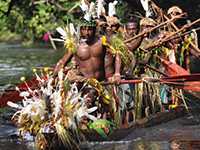
From Papua New Guinea to the tar sands of Alberta, Canada, native people…
 Standing on Sacred Ground: Islands of Sanctuary
Aboriginal Australians and Native Hawaiians reclaim land from the government…