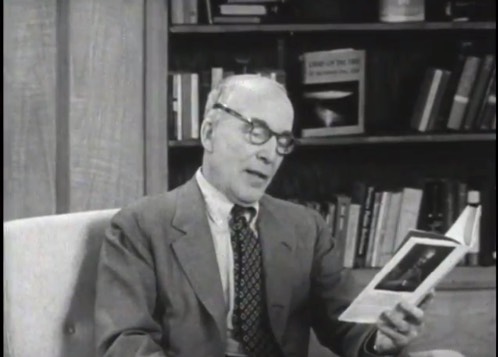
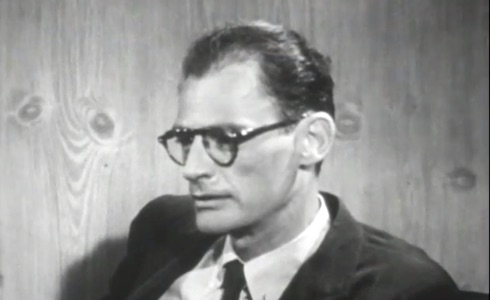
Walter Kerr interviews Arthur Miller.
Writers of Today: Frank O'Connor
- Description
- Reviews
- Citation
- Cataloging
- Transcript
If you are not affiliated with a college or university, and are interested in watching this film, please register as an individual and login to rent this film. Already registered? Login to rent this film.
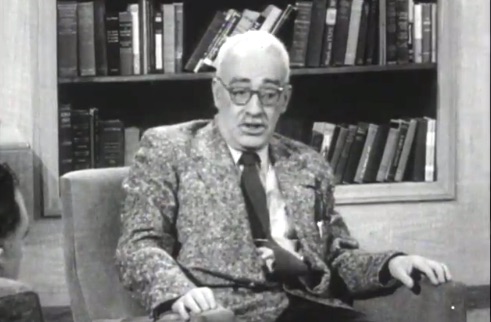
Each volume of WRITERS OF TODAY is a dialogue between noted literary critic Walter Kerr and one of the best known writers of our time. Produced in the 1950s, these programs provide rare profiles of these men as they discuss contemporary literature and society at the time of their own writing peaks.
O'Connor defends the often maligned short story. He argues that a proper short story cannot 'be developed' into a longer work because novels revolve around an individual's relationship to society, and how that individual integrates into it. A short story, to O'Connor, is about an individual's relationship to other individuals, or to himself. O'Connor also points out the different uses of time in the long and short forms, and goes on to defend greater objectivity in writing, speaking against the 'mood' story, as he feels that mastery of the visible universe will ultimately result in its illumination.
No reviews available.
Citation
Main credits
Kerr, Walter (Host)
Bobker, Lee R (Director)
Distributor subjects
No distributor subjects provided.Keywords
America; biography; writing; culture; literature; "Writers Of Today: Frank O'connor"; Icarus Films;
Writers of Today: Frank O'Connor
[00:00:42.33] I'm Walter Kerr. And this is another in a series of programs called Writers of Today. In this series we have an opportunity to sit down and chat with some of the most distinguished writers of our time, to ask them pertinent and sometimes impertinent questions about their work, about the way they do the work, and about their thoughts about writing and perhaps the world today.
[00:01:08.09] Our guest now is Mr. Frank O'Connor, who has been both a man of action and a man of thought in his time. Once one of the directors of the Abbey Theatre in Dublin, a teacher in many institutions, a drama critic for Holiday magazine, Mr. O'Connor is best known as a writer of short stories. In fact, some of the most brilliant, distinguished, delightful short stories of our time. Suppose we join Mr. O'Connor.
[00:01:41.82] Mr. O'Connor, I suppose there are still a great many people who think of the short story as a kind of test flight for an eventual novel. I gather that you don't.
[00:01:55.12] Not entirely, no.
[00:01:57.35] You don't think of it as preparatory work or as experimentation toward a longer form?
[00:02:02.10] Well, if that had been the case, I would have done something serious in the longer form by now. But I've already made two experiments with the novel. And I didn't succeed.
[00:02:11.43] Oh, you have tried novels.
[00:02:12.53] I have, yes. They have disappeared.
[00:02:15.95] I see. That suggests to me that you think there's not only a difference in form between the novel and the short story, but also a difference in the talent, the equipment for writing these things.
[00:02:27.89] I think an enormous difference, actually. I explain it to myself in various ways, always different ways, and always very interesting to me at the time. But there is, you know, a difference between a novel and a short story, merely in geographical distribution.
[00:02:45.84] I mean if you take the English, they have a very great novel. They have no short story writers up to AE Coppard. The French have a great novel. They have just one short story writer, Maupassant, whom a lot of people don't like.
[00:03:02.94] The Russians have both great novelists and great short story writers. And the extraordinary thing is here is Germany, with no novelists right through the 19th century at all. And that in itself is an indication that there is some difference between the novel and the short story.
[00:03:21.53] Well, now why should a country, let's take England, have such a magnificently developed novel and no short story, or in the case of Ireland, where the short story has grown and grown and grown, but I think no very major novels, yet. Is that right?
[00:03:37.89] I think that's perfectly correct, Mr. Kerr. And I think actually there you've made a very neat point if you make the contrast between England and Ireland. I think the novel is concerned with the individual in relation to society. And I get the impression that the problem of the novel is all the time how you are going to adjust your individual to society.
[00:04:02.63] You may fail eventually, as in Tess of the d'Urbervilles. Or you may succeed as in almost any of Trollope's novels. But there's got to be a society into which that individual can be absorbed.
[00:04:15.88] Now, I don't think there's any such society in Ireland today. I remember Henry James said somewhere that in his day in America there was no such society. And I think that when you don't get a society like that, the tendency is to write the short story merely because it's the lonely, individual voice.
[00:04:36.11] Well, now England then would not have developed the short story precisely because the social structure is so emphatic and so firm that the individual doesn't feel lonely. Is that it?
[00:04:46.80] I think that's true. I think the individual in Russia during the 19th century sometimes felt very lonely and at the same time had some hope of a new form of society in which he could live more happily.
[00:05:00.84] I see. You think hope is enough to create the novel, I mean the hope of a society?
[00:05:05.15] I think so, because again you get the same thing in America in our own time. You get a fine school of novelists. And you get some really great short story tellers. And it's as though the American could say, well, we shall do our best to adjust ourselves to society, to improve society. But at the very worst we'll always be able to fall back on ourselves.
[00:05:31.49] Now in the short story, I know that you have said from time to time in your various writings that one of the great distinctions between the short form and the novel is the matter of time, that in a sense time is one of the principal characters of a novel. Would you care to amplify that?
[00:05:48.98] Yes. Again, it's one of these almost analogical explanations that I give myself for the difference. I'm not even certain that it's true. But it sometimes seems to me that in a novel, the crisis of a novel is the result of all the factors that have led up to it. The difference with the short story writer is that the everything that precedes the crisis in a short story might almost be said to be a result of the crisis. You're thinking in terms of the crisis, not of the events that lead up to the crisis.
[00:06:23.78] I see.
[00:06:24.72] The novelist is thinking in terms of time. He loves this chronological build up. The short story writer is always scared. I'm always scared about, now, can I really develop this thing? No, no, no, no. Which is the central point? How do I get to it quick?
[00:06:41.98] And all the time I find myself looking for this one central point at which I can look back on what's happened and look forward to what's going to come. And I think that's characteristic of most short story writers.
[00:06:54.95] I see. Now you said something about change in the novel. And yet, I think that you don't mean to say that there is no change taking place in the short story. There is a change at this crisis of some kind?
[00:07:06.71] Oh Lord, yes. I mean this is what the short story is trying to achieve. The crisis is so important to the short story writer that I sometimes describe it to my students almost as the bending of an iron bar. You've got to feel the crisis in a short story as you don't have to feel it in a novel. You don't have to feel that life has been wrenched violently from one direction and sent off into another.
[00:07:31.04] I see. The characters are changed radically in this moment of crisis.
[00:07:35.36] That's the way I'd love to feel them. Mind you, one doesn't always succeed.
[00:07:40.03] I see. Well then, you would be opposed in general to what might be called the mood short story, if it's only a mood short story.
[00:07:46.36] I'm terribly opposed to it.
[00:07:47.29] Oh, you are.
[00:07:48.08] I am. I think that's something that's developed-- one of the things that really cured me of the mood short story was the first time I heard a short story of my own broadcast. I listened to this dreadful Irish voice. And I didn't recognize it until somebody told me who it was.
[00:08:11.28] And then I listened to this extraordinary prose, entirely full of dependent clauses. And finally, I looked at this extraordinary construction, brilliantly balanced scenes and all the rest of it, and realized that not one single word could get over to a listener, and that the modern short story had lost all its narrative impulse.
[00:08:32.98] It interests me very much to hear you say that this decision you made about in a sense abandoning the story of mood or the mood piece and turning to narrative came as a result of a radio broadcast. Do you feel that this kind of concern for the popular audience is valuable and important to you?
[00:08:53.59] Yes. I'm all for the popular audience. But actually, I don't think the short story writer really writes for an audience at all. I think the storyteller has an audience of his own.
[00:09:07.72] It's a modern art. It's written for the printed page. It's written for the solitary reader who can read and put down the book and test the truth of what you're saying. Consequently, we get the whole development of fiction in terms of this critical, intelligent reader.
[00:09:29.63] You cannot do to the reader what you can do in the theater. I mean, Shakespeare, as you know, gets away with murder in the theater. But the storyteller can't. And what I did feel when I heard that was that the individual reader was being lost sight of.
[00:09:47.66] You know, in a story like Joyce's "The Dead," which is a wonderful story, here you get something which couldn't possibly be told over there. You get something which is built on a whole system of analogy and antithesis. It's got all sorts of literary puns. Unless you have the whole story before you all the time, you're missing the point he's making.
[00:10:13.70] One of my favorite examples of Joyce's technique is the way he uses puns in that story. Greta, do you remember, takes three mortal hours to dress. She takes three dead hours to dress. And here are effects which simply cannot be got over to the solitary reader at all. What Joyce is doing there is he's replacing the solitary reader of the old 19th century story teller by a reader who is identical with himself in every possible way.
[00:10:50.44] And I sometimes feel about the mood story that you could say that the writer isn't writing for any particular person at all. He's talking to himself all the time. And suddenly I got this feeling that there was an enormous stoplight ahead of me. And if I went any further in this direction, I was in for trouble. So then I worked very hard at radio technique until I mastered it to a degree where I nearly destroyed myself again.
[00:11:20.63] Now, it started out helping you. But it wound up hurting you.
[00:11:23.92] I think so. I went too far with it. I found that I was trying to resurrect the art of the old minstrel. I wanted musical backgrounds to my stories. I wanted to act these stories out.
[00:11:40.74] And finally the terrible day came when I gave one of these stories, a very, very successful one, to an editor. And I looked at and realized that this was something again that the solitary reader couldn't take. What I was trying to do was replace the persuasion of the 19th century storyteller by compulsion.
[00:12:02.44] That's what the dramatist does. You compel the reader's attention. And the storyteller can't afford to do that. So then I had to backtrack quite a lot again. That particular story, which is now published in one of my collections under the title of "Judas" took me two years to get it to a point where I had got rid of this element of compulsion.
[00:12:26.18] I gather from various things you've said that you consider this an important distinction between the short story and the yarn or the simple narrative of the minstrel.
[00:12:39.41] Yes. And that, I think, is the mistake I made myself. I think the short-- the narrative of the minstrel is really a form of theater. There are two stories I can think of which illustrate that. I remember Yeats saying to me once, "the only secret of a successful play is give them a surprise every five minutes."
[00:13:07.29] And then years later, I had a great old friend, wonderful old man, a tailor in West Cork, who was the greatest natural storyteller I think I've ever listened to in my life. I sat listening to him for hours, a wonderful man full of talent and beauty of expression.
[00:13:27.87] But he learned that I was in the same trade as himself, so he got some visitors to his house to read him a couple of my stories. And he was bitterly disappointed. And he said, ah, Frank isn't too bad at all, you know, as a storyteller. But there aren't enough marvels in his stories.
[00:13:47.24] So you see, Yeats is surprise every five minutes and the tailor's marvels mean that both of them are really thinking of an audience. They're thinking of impressing that audience. And the danger for the storyteller is to have an audience, rather than one reader.
[00:14:04.46] Now we've been talking mostly so far I think about the shape of the short story as you conceive it. I'd like to ask you a few questions about changing styles in the short story. And we've already touched a little bit on the matter of subjectivity. You, I think, feel that the strictly subjective story, the stream of consciousness in a way, has pretty much outlived its usefulness.
[00:14:30.49] I think so. I think that that is part of the general history of fiction. And you can see this extraordinary change coming somewhere about 1880. You can truthfully say that no classical novelist emerges after 1880.
[00:14:48.71] Henry James begins as a disciple of Flaubert, [INAUDIBLE]. And halfway through, his work changes its nature. It becomes metaphysical. And you begin to wonder what exactly the symbols mean.
[00:15:03.21] Whenever I read Henry James, I'm always coming across the term American, and quite obviously, he doesn't mean American, and European, and he doesn't mean European, and money, money, money, all the time. And yet Henry James was a great artist. Obviously he wasn't thinking about money all the time.
[00:15:20.28] And somewhere it's changed. It's turned into symbolic values. And in that way, he is the link, he is the perfect link between the classical novel, which ended in 1880 with sometime around then Trollope died, and the modern novel of Lawrence and Proust, which is the other side of the mirror. It's man turning in on himself. And I think that was a phase that exhausted itself in Finnegan's Wake.
[00:15:46.03] With Joyce's Finnegan's Wake, you feel that the whole mood of subjectivism came to its logical end and a kind of blank wall.
[00:15:55.01] Yes. That's the feeling I have about it. You know, I think two things happened simultaneously, Buchenwald and Finnegan's Wake. And [INAUDIBLE], the French writer whom I admire enormously, says when the Allied troops broke into Buchenwald, what they found there was a poem of Baudelaire's. What he really means is that that whole phase of subjectivity is summed up in Buchenwald. And I think after that, there was nowhere else for the individualizing mind to go.
[00:16:33.57] Now, usually there's a very close relationship between the general literary style of a period, the attitude of a period, and some sociological or philosophical notion that grips the whole of mankind for that period outside literature. What was it do you think brought about this intense subjectivism and introspection that lasted from about 1880 to Buchenwald?
[00:16:59.19] Yes. It's awfully hard to say. You know, there are a number of factors involved in it. One thing is that that was a recrudescence of 18th century romanticism about that period in Oscar Wilde. All that romanticism that had been suppressed towards the end of the 18th century and which had been running underground began to surface.
[00:17:23.32] And curiously, it began to surface through the American writers who had gotten it from the Germans. You get a man like Poe. You get Melville. You get Hawthorne. Finally you get James using symbolism in the way in which symbolism had been used in the 18th century.
[00:17:42.36] I see.
[00:17:42.74] And that suddenly joins up with Freudianism. 1903 is the great date there, when Freud's book on dreams was published. And suddenly all these symbols, which nobody had understood, assumed a new value.
[00:18:01.96] And then, of course, it wasn't only that. You get a different conception of the individual coming from Freud. You take the characters of Faulkner, of Proust, of Joyce, they're paralyzed in their wills.
[00:18:22.64] The idea of Freud, the idea that everything that was important in our lives had happened before we had any control over our destinies had given the people the idea that the old individual had broken down. He didn't exist any longer. He was a freak. He was an accident.
[00:18:40.60] He was helpless.
[00:18:41.29] He was helpless in face of destiny.
[00:18:43.39] I see.
[00:18:43.86] And consequently, I think that is largely responsible for the subjectivity that followed. And it ended in the two disasters.
[00:18:53.32] I see. There's a close connection in your mind between symbolism and the introspective subjective school, then?
[00:19:01.80] Oh Lord, yes. I mean, you know yourself, you've taught literature. And you can see that the moment a man becomes subjective, he wants to express himself in symbols, rather than in realities. You field with a writer like Jane Austen that even though the symbols are there at the back of her mind, she watches them all the time until she's reduced them to something real, something concrete.
[00:19:27.94] Yes. I see. Now, since that time, since Buchenwald, as you say, and since the carrying of the subjective to its uttermost extension, and in a sense, finally failure or collapse or exhaustion might be a fairer word, what do you think we've done since then? I mean, are we moving in a given direction now, or since that time?
[00:19:45.93] That's an awfully hard question, Mr. Kerr, as you know, because we're only realizing now what people were doing in the '20s. And I just get odd notions from reading that there's a difference in tone, for instance, in the work of a writer like CP Snow from the work of anybody who came before him. I was delighted to read a long essay on his work in The Times Literary Supplement a year or two ago in which the reviewer complained bitterly that Mr. Snow was not taking the novel forward from Joyce. He was taking it back to Trollope.
[00:20:23.54] I assume you don't mean that we are going back to Trollope precisely, but that we are looking for a new form of dealing with the concrete, rather than the subjective universe.
[00:20:35.51] Yes. I think generally literature never goes back at any rate. Every bit of experience that's come into literature through Proust and through Joyce and through all the rest of them has to be absorbed into any new thing you create. On the other hand, I do think that we've become rather powerless in front of life. And what I see in the work of people like Snow and [INAUDIBLE] and I think in the work of Joyce Cary is a new attempt at getting control of life, a new attempt at handling it as it was handled in the 19th century.
[00:21:15.96] So our problems now are not so much internal and subjective. Problems they are external and very real problems, is that right?
[00:21:23.04] Yes. Right. And I think we've got to externalize them where they are.
[00:21:27.38] Look at them for what they are.
[00:21:29.39] Yes. Try to project them as much as we can outside ourselves.
[00:21:32.09] Now when we return to this concrete and objective reality as writers to try and deal with it, are we then going to try to explain it to people or illuminate it for people?
[00:21:43.64] If we present it truthfully, I should say it illuminates itself. I mean--
[00:21:48.19] Now, what do you mean by that?
[00:21:49.46] I mean any aspect of reality that you present with truth, and I'm also inclined to say with love, has its own illumination in it.
[00:22:00.65] I see. So that if we are simply faithful to life and to a life quite objectively seen, that something of its brilliance and something of its greatness will come to us.
[00:22:11.70] One hopes so.
[00:22:12.75] This is the object of the writer in any case.
[00:22:14.66] All the time.
[00:22:15.81] I see. What I'd like to do, if you are willing, is to get us a little sense of your own tone in your own work. Would you mind reading an excerpt from one of your stories, perhaps "First Confession?"
[00:22:27.75] Every writer loves to be invited to read, Mr. Kerr.
[00:22:30.91] Oh, he does. I see. All right. Well, then, I'm going to invite you to, if you will.
[00:22:34.95] Thanks. This is a story, you probably know it, about a small boy who goes to confession and doesn't want to go to confession, because he is a terrible sin on his soul. And finally, he manages to get a hold of a nice priest. And he tells him of this terrible sin.
[00:22:56.70] "The next time, the priest steered me into the confession box himself. And he left the shutter back so that I could see him get in and sit down at the farther side of the grill from me. 'Well, now,' says he, 'what do they call you?'
[00:23:11.80] 'Jackie, Father,' said I. 'And what's the trouble to you, Jackie?' 'Father,' said I, feeling I might as well get it over while I had him in good humor, 'I had it all arranged to kill me grandmother.' He seemed to be a bit shaken by that all right, because he said nothing for quite a while.
[00:23:32.00] 'My goodness,' he said at last. 'That'd be a shocking thing to do. Now, what put that into your head?'
[00:23:38.23] 'Father,' I said, feeling very sorry for myself, 'she's an awful woman.' 'Is she,' he asked. 'Now, what way is she awful?'
[00:23:46.18] 'She takes porter, Father,' I said, knowing well from the way Mother talked of it that this was a mortal sin, and hoping it would make the priest take a more favorable view of my case.
[00:23:57.07] 'Oh my,' he said, and I could see that he was impressed. 'And she takes snuff, Father,' said I. 'That's a bad case, sure enough, Jackie,' he said.
[00:24:05.48] 'And she goes around in her bare feet in the house, Father,' I went on in a rush of self-pity. 'And she know I don't like her. And she gives pennies to Nora. And she gives none to me. And me dad sides with her and he flakes me. And one night I was so heart-scalded I made up me mind I'd have to kill her.'
[00:24:23.54] 'And what would you do with the body,' he asked with great interest. 'I was thinking I could chop that up and carry it away in a barrow I have,' I said. 'Begor, Jackie,' said he, 'Do you know you're a terrible child?'
[00:24:35.28] 'I know, Father,' I said, because I was just thinking the same thing myself. 'And I tried to kill Nora too with a bread knife under the table, only I missed her.' 'Is that the little girl that was beating you just now,' he asked. ''Tis Father,' said I.
[00:24:48.46] "Someone will go for her with a bread knife one day and won't miss her,' he said. 'You must have great courage, though, because between ourselves there's a lot of people I'd like to do the same thing to. But I'd never have the nerve. Hanging is an awful death.'
[00:25:00.87] 'Is it, Father," I asked with the greatest interest. I was always very keen on hanging. 'Did you ever see a fella hanged?'
[00:25:07.82] 'Dozens of them,' he said solemnly. 'And they all died roaring.' 'Oh, gee,' I said.
[00:25:13.82] 'Oh, it is a horrible death,' he said with great satisfaction. 'And lots of the fellows I saw killed their grandmothers too. But they all said it was never worth it.
[00:25:21.68] He had me there for a full 10 minutes talking. And then he walked out the chapel yard with me. I was genuinely sorry to part with him, because he was the most entertaining character I'd eve met in the religious line.
[00:25:32.41] Outside, after the shadow of a church, the sunlight was like the rolling of waves on a beach. It dazzled me. And when the frozen silence melted and I heard the screech of trams on the road, my heart soared. I knew now I wouldn't die in the night and come back leaving marks on me poor mother's furniture. It would be a great worry to her. And the poor soul had enough.
[00:25:53.44] My sister Nora was sitting on the railing waiting for me. And she put on a very sour puss when she saw the priest come with me. She was mad jealous, of course, because a priest had never come out of the church with her.
[00:26:06.19] 'Well,' she said coldly, after he'd left me. 'What did he give you?' 'Three Hail Marys,' said I.
[00:26:14.12] 'Three Hail Marys,' she repeated incredulously. 'You mustn't have told him anything.' 'I told him everything,' I said.
[00:26:21.75] 'About Gran and all?' 'About Gran and all.' Of course, all she wanted was to be able to go home and say that I'd made a bad confession.
[00:26:32.15] 'Did you tell him you went for me with a bread knife,' she asked with a frown. 'I did, to be sure.' 'And he only gave you three Hail Marys?' 'That's all.'
[00:26:43.36] She got down slowly from the railing with a baffled air. Clearly, this was too much for her. As we mounted the steps back to the main road, she looked at me suspiciously.
[00:26:53.00] 'What are you sucking,' she asked. 'Bullseyes' I said. 'Was it the priest gave them to you?' ''Twas.'
[00:27:02.24] 'Lord God,' she wailed bitterly. 'Some people have all the luck. 'Tis no advantage to anybody trying to be good. I might just as well be a sinner like you.'"
[00:27:13.70] Thank you very much. Mr. Frank O'Connor has been talking to us about the difference between the short story and the novel, the essential difference being that in the novel an individual is seen in relation to an entire social structure, whereas in the short story the individual is considered in his relation to other individuals or to himself.
[00:27:33.29] However, he points out that the day of a subjective treatment of the individual is passing, that today we're concerned much more with concrete reality, with mastering the visible universe, and that if we master it with dignity and with honor and with some kind of objectivity, it will somehow illuminate itself for us.
Distributor: Icarus Films
Length: 30 minutes
Date: 1991
Genre: Interview
Language: English
Color/BW:

Closed Captioning: Available
Interactive Transcript: Available
Existing customers, please log in to view this film.
New to Docuseek? Register to request a quote.
Related Films
Writers of Today: Arthur Miller